



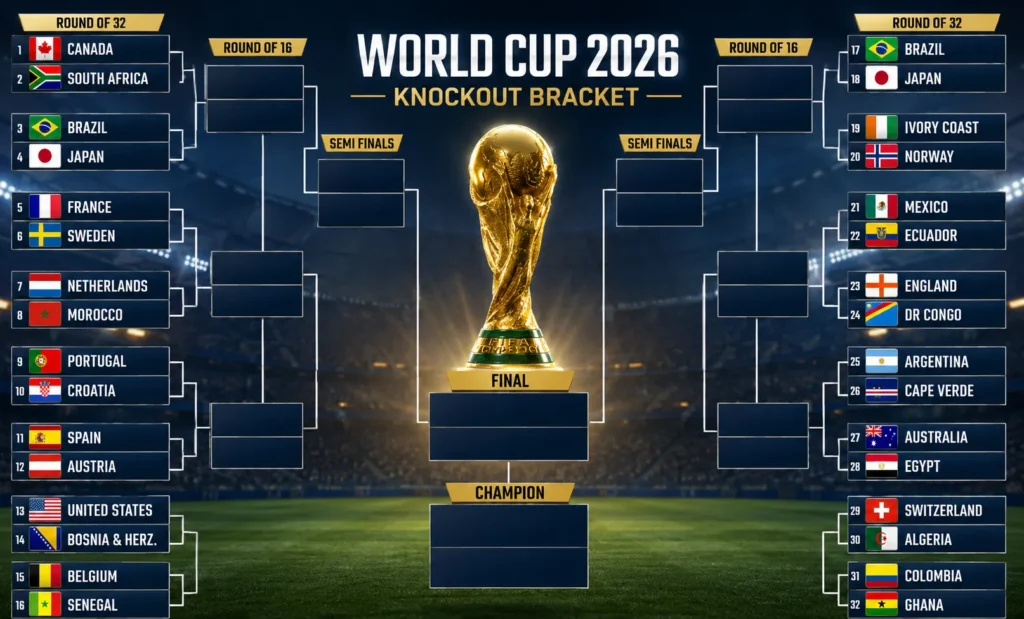
The World Cup 2026 knockout bracket has officially blown the safety net away. The calculated patience and goal-difference math of the group stage are gone, replaced by the raw, unforgiving reality of single-elimination football. With the expansion to a 48-team field, the opening weeks felt like a chaotic sorting process. Now, the margin for error is zero. A heavy touch in the box, a mistimed tackle, or a single lapse in concentration will end a country’s dream in an instant. There are no second chances, no bouncing back in the next match, and nowhere to hide. You win on the night, or you pack your bags.
Canada’s Historic Opening Statement
Co-hosts Canada didn’t just kick off the Round of 32; they set the tone for what this new era of the tournament looks like. Facing a stubborn South Africa team in the bracket’s opening match, the Canadians ground out a disciplined, high-intensity 1-0 victory that sent a massive wave of energy through the entire country. This wasn’t just a narrow win to get across the line it was a definitive moment for Canadian football, a massive reward for local fans, and a warning to the rest of the field that the hosts aren’t just here to manage logistics and welcome guests.
The sheer maturity of Canada’s performance showed a squad that has fully outgrown its old underdog label. They sat deep when they needed to, absorbed waves of pressure, controlled the game’s rhythm, and struck with clinical precision at the perfect moment. By locking down a spot in the Round of 16, this team has written itself straight into national sports folklore. The resulting momentum is already spilling off the pitch, packing out local fan zones, and driving ticket demand through the roof.
How the Expanded World Cup 2026 Knockout Bracket Changes the Game
The decision to expand the tournament to 48 teams did a lot more than just crowd the summer schedule; it completely broke and rebuilt the competitive structure of international football. Adding the Round of 32 introduces a brutal, highly unpredictable layer right at the start of the World Cup 2026 knockout bracket.
In the old 32-team format, winning your group gave you a clear reward: a direct path to the Round of 16 and a vital chance to rest bruising muscles or protect players on yellow cards. In 2026, that privilege is dead. The road to the trophy has transformed from a six-game sprint into a punishing seven-game marathon where even the world’s elite must start from scratch the second the group stage ends.
Managing this massive grid presents teams with a brutal set of real-world challenges:
- Logistical Exhaustion: Squads are flying across three massive countries the United States, Mexico, and Canada. Bouncing between varying time zones, changing altitudes, and completely different climates within a few days is a massive headache for medical staffs.
- The Yellow Card Minefield: With an extra sudden-death match added to the mix, players carrying bookings from the group stage face a massive risk of picking up suspensions that could rule them out of massive later rounds.
- The Wildcard Factor: Because the eight best third-place finishers scraped into the Round of 32, the bracket is full of dangerous teams playing with pure house money. With absolutely nothing to lose, these squads are a nightmare for heavyweights who might coast into the match expecting an easy ride.
Key Operational Dynamics of the Knockout Phase
Surviving this stage requires more than just raw talent on the pitch. The teams that advance are the ones that can adapt to the hidden structural and psychological shifts that define knockout football.
What Makes the Round of 32 Unique?
- The Great Equalizer: Historic reputations, expensive squads, and past trophies don’t mean a thing once the whistle blows. Big teams can’t afford to slowly play their way into form anymore; they have to hit their peak immediately.
- Clash of Styles: The expanded format brings together football cultures that rarely face each other in normal international cycles, creating weird, fascinating tactical puzzles on the field.
- The Host Nation Hot Seat: With matches happening in iconic North American venues, the pressure on the remaining hosts, Mexico and the United States, is boiling over as fans expect them to mirror Canada’s flying start.
The Tactical Chess Match: What Will Decide the Bracket?
As teams prepare for sudden-death football, the open, expressive play of the group stage naturally dries up. Managers know that a single mistake can ruin a four-year cycle, so pragmatism takes over.
A few critical tactical trends are already deciding who stays and who goes home:
- The Set-Piece Premium: When elite defensive lines drop deep and space in the box vanishes, dead-ball situations become pure gold. A clever near-post run on a corner or a flash of individual genius over a defensive wall on a free-kick is often the only thing separating a 1-0 win from the chaos of a penalty shootout.
- Weapons Off the Bench: International football is no longer about just the starting eleven; it’s a 26-man game. With the distinct threat of matches stretching into 120 minutes of exhausting extra time, managers are holding back specific players as “finishers.” Bringing on electric pace against a tired fullback in the 80th minute has become a primary tactical strategy.
- Surgical Counter-Attacking: Powerhouses like Brazil, France, and Spain will always want to dominate the ball and pin opponents back. But overcommitting numbers forward is incredibly dangerous. Teams like Japan, Morocco, and Ecuador are perfectly drilled to absorb heavy pressure and launch lightning-fast breaks that expose high defensive lines.
- The Mind Games of Penalties: When the match goes down to spot-kicks, a goalkeeper’s presence and study habits matter more than anything. Teams that have spent months analyzing historical penalty data and opponent body language hold a massive psychological edge before a single ball is kicked from twelve yards out.
The Road Ahead: Who Is Standing Tall?
The remaining teams in the bracket can be split into three distinct categories, each dealing with its own version of pressure and expectation.
1. The Heavyweight Titans
Brazil, Argentina, France, and England carry the suffocating weight of their footballing histories. They have the deepest squads and the biggest superstars, meaning anything less than a run to the final week is treated as an embarrassing national failure. Their biggest challenge right now isn’t the opposition; it’s internal panic. If an early goal doesn’t arrive, the anxiety from the stands can lock up their creativity.
2. The Tournament Veterans
Teams like Croatia, the Netherlands, Colombia, and Belgium are built for this kind of tension. They don’t care about possession percentages or looking pretty on television. They are perfectly comfortable playing ugly, slowing down the tempo, frustrating creative players, and capitalizing on the one or two chances they get across 90 minutes.
3. The Bracket Spoilers
Norway, Senegal, Ghana, and Algeria are the wildcards that every top seed wants to avoid. Playing with a freedom that the traditional giants don’t have, these teams can turn any match into a physical, chaotic scrap. They have the athleticism, tactical discipline, and elite forward talent to ruin anyone’s tournament on any given night.
Why This Phase Is a Commercial and Economic Juggernaut
Beyond the white lines of the pitch, the Round of 32 marks the exact moment the World Cup transitions from a sports tournament into a global cultural phenomenon.
For the 16 host cities across North America, the financial stakes are massive. Unlike the group stage, where fan travel is planned months in advance, knockout football triggers a chaotic, real-time migration. The moment a final whistle blows, thousands of winning fans instantly scramble to book flights, secure hotels, and flood local transit networks in whichever city their team plays next. This creates an immediate, high-volume revenue spike for local hospitality economies.
This sudden-death setup is also prime real estate for broadcasters and corporate sponsors. Casual fans who skipped the daily grind of the group stages flock to their screens for the high-stakes drama of single-elimination football. This massive wave of focused global attention drives advertising rates to their peak, shatters streaming records, and completely takes over social media timelines.
Full Tournament Schedule to the Final
The countdown to the grand finale is officially underway. The pressure on the remaining squads will only intensify as the calendar moves deeper into July.
| Stage | Operational Dates | The Tournament Stakes |
| Round of 32 | June 28 – July 3 | 32 teams enter the sudden-death matrix; exactly half the field is eliminated. |
| Round of 16 | July 4 – July 7 | The remaining 16 nations battle for a coveted spot in the elite final eight. |
| Quarterfinals | July 9 – July 11 | High-intensity, blockbuster matchups where tactical margins become razor-thin. |
| Semifinals | July 14 – July 15 | The ultimate high-pressure step before earning a ticket to the grand finale. |
| Third-Place Match | July 18 | The losing semifinalists play a pride-focused fixture for the bronze medal. |
| Final | July 19 | The pinnacle of world sport, where the 2026 World Champion is officially crowned. |
The Bottom Line
Canada has shown exactly what home advantage and tactical discipline can pull off in this expanded format. Now, the rest of the world has to prove they have the physical depth, mental toughness, and tactical flexibility to survive the longest, most unpredictable knockout path the sport has ever seen.
Whether the next few days bring an incredible underdog story or a clinical march to the trophy by the usual giants, the World Cup 2026 knockout bracket has already turned the tournament into an unmissable, high-stakes drama.

