


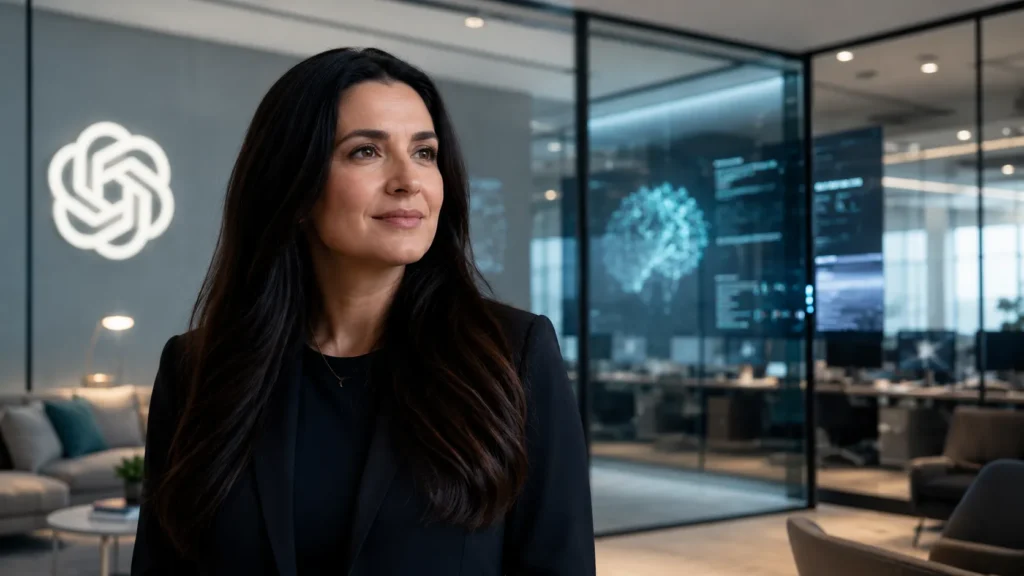
Fidji Simo is stepping away from her full-time role at OpenAI, bringing an early end to one of the company’s most important executive appointments.
The former Instacart chief had been serving as OpenAI’s CEO of Applications, a position created to bring together the product, business and operational sides of the company. She had been on medical leave before telling employees on July 9, 2026, that she would not return to the job in a full-time capacity.
Simo is expected to remain connected to OpenAI as a part-time adviser.
Her decision was tied to a worsening health condition and the need for a longer recovery. It was not presented as a disagreement with Sam Altman, a board dispute or a change in OpenAI’s broader direction.
That distinction matters. Executive exits at fast-growing technology companies often invite speculation about internal conflict. In this case, the available reporting points to a personal health decision with real consequences for the company’s management structure.
The timing is still difficult for OpenAI.
The company is trying to improve ChatGPT, grow its enterprise business, expand its coding products, build more capable AI agents and manage the huge cost of the infrastructure behind those systems. Simo had been hired to bring commercial discipline to those efforts and to reduce the amount of day-to-day operational responsibility sitting with Altman.
OpenAI now has to carry on without the executive chosen to lead that part of the business.
Key Takeaways
- Fidji Simo is leaving her full-time position as OpenAI’s CEO of Applications.
- She made the decision after an extended medical leave and a worsening chronic health condition.
- She will stay involved with OpenAI as a part-time adviser.
- Her former duties are likely to be divided among several senior executives.
- The change affects OpenAI’s product, revenue and operational leadership rather than its research teams alone.
- ChatGPT users are unlikely to see an immediate change.
- The long-term issue is whether OpenAI can keep clear accountability across a fast-growing and increasingly complicated business.
A Health Decision With Immediate Business Consequences
Simo’s message to employees made clear that her condition had become harder to manage and that recovery would take longer than she first hoped.
She has spoken publicly in the past about living with a chronic neuroimmune illness. Reports have identified the condition as postural orthostatic tachycardia syndrome, or POTS.
The condition can affect heart rate, circulation, stamina and the body’s response to standing. Some people experience dizziness, exhaustion, rapid heartbeat, faintness or difficulty completing normal daily activities.
Its effects are not the same for everyone. Symptoms can also change over time, which can make work planning difficult, particularly in a job built around constant travel, meetings, decisions and crisis management.
OpenAI is one of the most demanding workplaces in the technology industry. Its leaders are dealing with product launches, model development, policy pressure, safety questions, investors, strategic partners and competitors moving at similar speed.
For Simo, returning to that pace was no longer realistic.
Her move into an advisory position gives her a way to stay involved without carrying the daily burden of a full operating role. It also allows OpenAI to retain access to her experience, although in a much more limited form.
An adviser can offer perspective on major decisions. An adviser does not run teams, settle internal disputes or own weekly targets.
That difference is where the leadership gap begins.
Why OpenAI Created the CEO of Applications Role
When Simo joined OpenAI, the company had already moved far beyond the image of a research lab working on experimental artificial intelligence.
ChatGPT had become a consumer product with global reach. Businesses were using OpenAI models through workplace subscriptions, developer tools and enterprise contracts. The company was also expanding into image generation, research assistance, coding and task automation.
Research remained central, but research alone was no longer enough.
OpenAI needed a stronger system for deciding which products to build, how to package them, which customers to prioritize and how to turn expensive technology into a durable business.
That was the logic behind the CEO of Applications role.
Altman remained responsible for the company as a whole, including research, long-term strategy, computing infrastructure and external relationships. Simo was expected to oversee the part of OpenAI that sat closest to users and revenue.
The arrangement gave the company two distinct centers of focus.
One side would keep pushing technical capability. The other would make sure those capabilities became products that people could understand, trust and pay for.
Simo’s departure does not remove the need for that structure. It simply leaves OpenAI without the person chosen to lead it.
What Simo Was Responsible For
The title CEO of Applications could sound narrower than the role actually was.
Her responsibilities touched most of the functions required to turn AI research into a working commercial platform.
These included:
- Consumer products such as ChatGPT
- Business and enterprise offerings
- Product planning and launches
- Sales and revenue operations
- Commercial partnerships
- Customer growth
- International expansion
- Coordination between product, finance and operations
- The practical delivery of OpenAI technology to users
That combination made her one of the most influential people inside the company.
The work was not limited to feature decisions.
A company such as OpenAI has to decide how much computing power to allocate to free users, paid subscribers, developers and large corporate customers. It must determine which features are ready for release, which need more safety testing and which may be too expensive to support at scale.
It also has to explain its products to customers who may not understand the technical differences between models.
Those are business questions, product questions and financial questions at the same time.
Simo’s role sat at the point where they all met.
Why Her Background Fit OpenAI’s Needs
Simo came to OpenAI with experience that was unusually relevant to the company’s next stage.
At Instacart, she ran a business that had expanded rapidly during the pandemic and then had to adjust as consumer habits changed. She dealt with growth, costs, investors, employees and public-market expectations.
Before Instacart, she spent more than a decade at Facebook, now Meta, and eventually led the main Facebook app.
That role exposed her to the realities of operating a global consumer platform. Product growth had to be weighed against privacy, regulation, public criticism, advertising demands and user safety.
OpenAI was facing its own version of that challenge.
ChatGPT had grown quickly, but popularity created pressure. Users wanted faster answers and better features. Businesses wanted stronger security and clearer pricing. Regulators wanted accountability. Investors wanted a path toward a more stable business.
Simo understood what happens when a product becomes too large to be managed like a startup experiment.
She had also served on OpenAI’s board before moving into the executive role, which meant she already knew the company, its mission and some of its internal tensions.
Her appointment looked like an effort to add experienced operating leadership without weakening the influence of the research side.
OpenAI Is Spreading the Work Across Several Executives
There does not appear to be an immediate plan to hand Simo’s full portfolio to one person.
Instead, OpenAI is dividing the work among executives who were already carrying more responsibility during her medical leave.
| Executive | Current Position | Main Area of Responsibility |
| Greg Brockman | President and co-founder | Product direction and coordination |
| Sarah Friar | Chief financial officer | Finance, planning and operational discipline |
| Jason Kwon | Chief strategy officer | Corporate strategy and company priorities |
| Denise Dresser | Chief revenue officer | Sales, customer relationships and revenue |
| Sam Altman | Chief executive officer | Overall leadership and long-term direction |
On paper, this gives OpenAI experienced people in each major area.
Brockman can stay close to product development. Friar can focus on spending and financial planning. Dresser can keep attention on customers and revenue. Kwon can manage broader strategic priorities.
The question is how these roles will work together when priorities collide.
A product team may want to release a feature quickly. A finance team may see the computing cost as too high. Sales staff may already be promising the feature to enterprise customers. Safety teams may want more testing.
When one executive owns the entire applications business, that person can make the final call.
With shared leadership, decisions may take longer or end up returning to Altman.
That does not mean the structure will fail. Many large companies operate through distributed leadership. The risk comes when authority is unclear.
OpenAI now has to make that authority visible inside the company, even if it does not announce a new CEO of Applications immediately.
Product Strategy May Become Harder to Coordinate
ChatGPT is no longer one simple product.
OpenAI serves individual users, students, developers, startups, large companies and public institutions. Each group has different needs.
A casual user may care about speed and ease of use. A developer may care about coding accuracy, tool access and pricing. A bank may care more about data controls, legal risk and service reliability.
OpenAI is also adding more product categories.
It has research tools, voice features, image generation, coding systems and agents designed to perform tasks across multiple steps. These products compete for engineering time, computing resources and executive attention.
A strong applications leader would normally decide where the company should concentrate.
Should OpenAI spend more on consumer growth or business customers? Should it put more resources into coding or general-purpose agents? Should it make advanced features cheaper to attract users, or more expensive to improve margins?
Those questions do not have purely technical answers.
They require judgment about the market, customer behavior and the company’s long-term position.
Simo was hired partly because she had made similar choices at large consumer platforms.
Her absence makes coordination more dependent on the relationship between Brockman, Friar, Dresser, Kwon and Altman.
Enterprise Customers Will Look for Continuity
The average ChatGPT user may not pay much attention to an executive departure.
Large corporate customers will.
Companies that use AI in important workflows want to know who is responsible for product direction, support, pricing and long-term commitments.
They also want confidence that the provider will still be stable a year or two from now.
OpenAI has dedicated sales and support teams, so Simo’s departure does not leave enterprise customers without help. Still, senior leadership changes can influence how large buyers assess risk.
A company considering a major OpenAI contract may ask whether the product roadmap will change, whether pricing will remain predictable and whether the same executives will be available during a difficult implementation.
The answers will depend less on public statements and more on day-to-day execution.
If OpenAI continues improving its enterprise tools, responding to customers and meeting commitments, concern will fade.
If product plans become less clear, the departure may receive more attention than it does now.
Denise Dresser will be important in that process. Revenue leadership is not only about selling more subscriptions. It is also about keeping customers confident enough to stay.
OpenAI’s Cost Problem Makes Financial Discipline More Important
The economics of advanced AI are difficult.
The more people use a service, the more infrastructure the company may need. Every response requires computing resources. More complex tasks can consume more of those resources.
OpenAI has to pay for chips, data centers, networking, electricity, cooling and highly specialized staff.
That means user growth can create both opportunity and pressure.
A traditional software product can often serve additional users at relatively low cost. AI products may become more expensive as usage and model complexity increase.
This is why pricing decisions matter so much.
OpenAI has to decide what remains free, what belongs in paid plans and what enterprise customers should pay for advanced capabilities.
It also has to manage the difference between products that attract attention and products that produce sustainable revenue.
Sarah Friar’s role becomes more important under this structure.
As chief financial officer, she must help determine how aggressively OpenAI can spend, where it should invest and how long it can support products that may not yet cover their own costs.
Simo’s experience with a public company could have helped connect those financial questions with product strategy.
Her advisory role may still provide useful input, but the daily responsibility now sits elsewhere.
Most ChatGPT Users Will See Little Immediate Change
Leadership changes usually move through a company slowly before they reach customers.
ChatGPT will not suddenly stop working because Simo has stepped down. The product is supported by large teams across engineering, research, design, safety and customer operations.
Updates will continue. New tools will still be released. Existing subscriptions will remain in place.
The more meaningful effects may appear over time.
A different leadership structure can change which products receive funding, which features are released first and how aggressively a company pushes users toward paid plans.
OpenAI may put more emphasis on business products, coding tools and agents that complete practical work.
It may also continue changing the gap between free and paid versions of ChatGPT.
Those trends were already underway. They should not be blamed on one executive departure.
Still, the people who inherit Simo’s responsibilities will influence how quickly those changes happen and how clearly they are explained to users.
AI Agents Are Becoming a Bigger Part of the Plan
OpenAI’s future is increasingly tied to systems that do more than answer questions.
An AI agent can take a request, break it into steps, use tools, search through information, prepare files or complete tasks inside software.
That is a different product from a chatbot.
The value may be higher because the system is not only offering advice. It is doing part of the work.
For businesses, that creates a clear commercial opportunity. A company may pay more for an AI system that completes useful tasks than for one that simply produces text.
The risks are also greater.
A wrong answer is one problem. A wrong action is another.
If an agent sends the wrong file, changes the wrong data or follows an unsafe instruction, the consequences may be more serious than an inaccurate chat response.
OpenAI has to build controls around permissions, privacy, reliability and human oversight.
It also has to make agents simple enough for ordinary people to use without understanding the technical system behind them.
This is exactly the kind of work that requires close cooperation between research, product, business and safety teams.
Simo’s former position was designed to help coordinate that cooperation.
Competition Is No Longer a Distant Threat
OpenAI still has one of the strongest names in artificial intelligence, but it does not have the field to itself.
Anthropic has built a strong position among developers and enterprise users. Claude is used for writing, research, coding and analysis, while Claude Code has become a serious tool for software work.
Google has a different advantage. It can place Gemini inside products millions of people already use, including search, Android, Workspace and Google Cloud.
Microsoft is expanding Copilot across its own software while remaining closely connected to OpenAI.
Meta is investing in open models, and smaller companies are building industry-specific products for law, medicine, finance, design and customer service.
OpenAI therefore has to compete on more than model quality.
It must offer products that are reliable, understandable and worth paying for.
That requires strong execution.
A company can have excellent research and still lose ground if its pricing is confusing, its products are difficult to use or its customer support is weak.
Simo was brought in because she understood that side of the business.
Other executives now have to show that the same discipline can survive without her in the full-time role.
A Short Tenure in a Crucial Position
| Date | Development |
| March 2024 | Simo joined OpenAI’s board while serving as Instacart CEO. |
| May 2025 | OpenAI announced that she would become CEO of Applications. |
| 2025 | She began leading major product, business and operational teams. |
| 2026 | Simo went on extended medical leave. |
| July 9, 2026 | She told employees she would not return full time. |
| After July 2026 | She will remain connected to OpenAI as a part-time adviser. |
The length of Simo’s tenure makes the transition more unusual.
OpenAI had only recently created a clear division between Altman’s broader leadership and Simo’s applications role. The company is now returning to a more shared model before that structure had much time to settle.
This does not mean the original decision was wrong.
It may instead show how strongly OpenAI still needs an executive who can bring together product, operations and revenue.
The Change Raises Questions About Governance
OpenAI has never had a simple corporate structure.
It began as a nonprofit before creating commercial entities capable of raising the large amounts of money needed for AI development.
That history has left the company balancing several interests.
Researchers want freedom and resources. Investors want growth. Customers want stable products. Regulators want accountability. The public wants confidence that powerful AI systems are being developed responsibly.
These priorities do not always align.
Strong leadership is needed to decide which concerns take priority and who has authority when they conflict.
Simo’s appointment was one attempt to make that system more manageable.
By giving the applications business its own senior leader, OpenAI could separate some operating decisions from Altman’s wider role.
Her departure may bring more responsibility back to Altman, even if it is formally distributed among other executives.
That would not be surprising. Founders and chief executives often regain control when a senior operating leader leaves.
The risk is that too many decisions begin moving through one person again.
OpenAI has grown too large for every important question to depend on its CEO.
What OpenAI Could Do From Here
The company has several options, and none is an obvious choice.
Hire Another Applications Chief
OpenAI could recruit a senior executive with experience in consumer technology, enterprise software or public companies.
This would restore the structure created for Simo and give the applications business one clear leader.
The challenge is finding someone with enough credibility to manage large teams while working alongside Altman and Brockman.
The person would also need to understand OpenAI’s unusual mission and governance system.
Promote Someone Already Inside the Company
An internal candidate would know the products, employees and culture.
That could make the transition easier.
However, OpenAI may not have one person who combines product judgment, sales experience, financial discipline and public-company knowledge.
Keep the Shared Model
The company may decide that the current group can handle the work together.
Brockman can guide product direction. Friar can manage finance. Dresser can lead revenue. Kwon can focus on strategy.
This approach avoids another major hire.
It will work only if decisions are made quickly and everyone understands where final authority sits.
Use Simo as a Senior Adviser
Simo can still offer advice on major product, leadership and business issues when her health permits.
She may also help OpenAI think through the qualities needed in a replacement.
But the company should not treat an advisory role as a substitute for full-time management.
The two are not equivalent.
Investors Will Judge the Transition Through Results
OpenAI is privately held, so there is no public share price reacting to the news.
The impact will be quieter.
Private investors, business partners and possible future shareholders will watch how the company performs after the change.
Some may see the departure as a sign of added risk. Simo brought public-company experience and was expected to strengthen operations.
Others may believe OpenAI already has enough capable executives to absorb the loss.
Both views are reasonable at this stage.
The next few months will provide the real answer.
Strong product releases, steady enterprise growth and clear leadership would suggest the transition is under control.
Missed deadlines, mixed messages or more senior departures would create a different impression.
For investors, the issue is not simply who holds the title.
It is whether OpenAI can make decisions, control costs and keep customers while operating at enormous scale.
The Personal Reality Should Not Be Lost
It is easy to discuss Simo’s decision only through the language of strategy and corporate risk.
That would miss the human part of the story.
Chronic illness does not disappear because a person holds an important title. A demanding job can make symptoms harder to manage, even for someone with access to excellent medical care and professional support.
Technology executives are expected to remain constantly available. They travel, attend long meetings, respond to crises and make decisions that affect thousands of employees and millions of users.
That pace can be difficult for anyone.
For someone dealing with a serious long-term condition, it can become impossible.
Simo’s choice to step back should therefore not be treated as a lack of ambition or commitment.
It was a decision shaped by health, and OpenAI appears to have accepted it without public conflict.
Keeping her involved as an adviser offers continuity while giving her room to recover.
OpenAI Now Has to Show That Its Leadership System Works
Fidji Simo was hired to help OpenAI grow into a more organized, commercially mature company.
That work remains unfinished.
OpenAI still needs to decide how products are prioritized, how costs are managed and how enterprise customers are supported. It still needs to turn advanced models into services people can use reliably.
The company has experienced leaders available to do that work.
Brockman understands the technology and product side. Friar brings financial discipline. Dresser is focused on customers and revenue. Kwon handles strategy. Altman remains the central decision-maker.
What OpenAI must prove is that these executives can operate as a coordinated group rather than as separate centers of influence.
Customers will judge the company by product quality. Businesses will judge it by reliability and support. Employees will judge it by whether decisions are clear. Investors will judge it by growth, costs and leadership stability.
Simo’s advisory role gives OpenAI access to her judgment, but it does not replace the daily authority she once held.
The next stage of the company’s growth will show whether the structure she was hired to lead can function without her at the center.

