


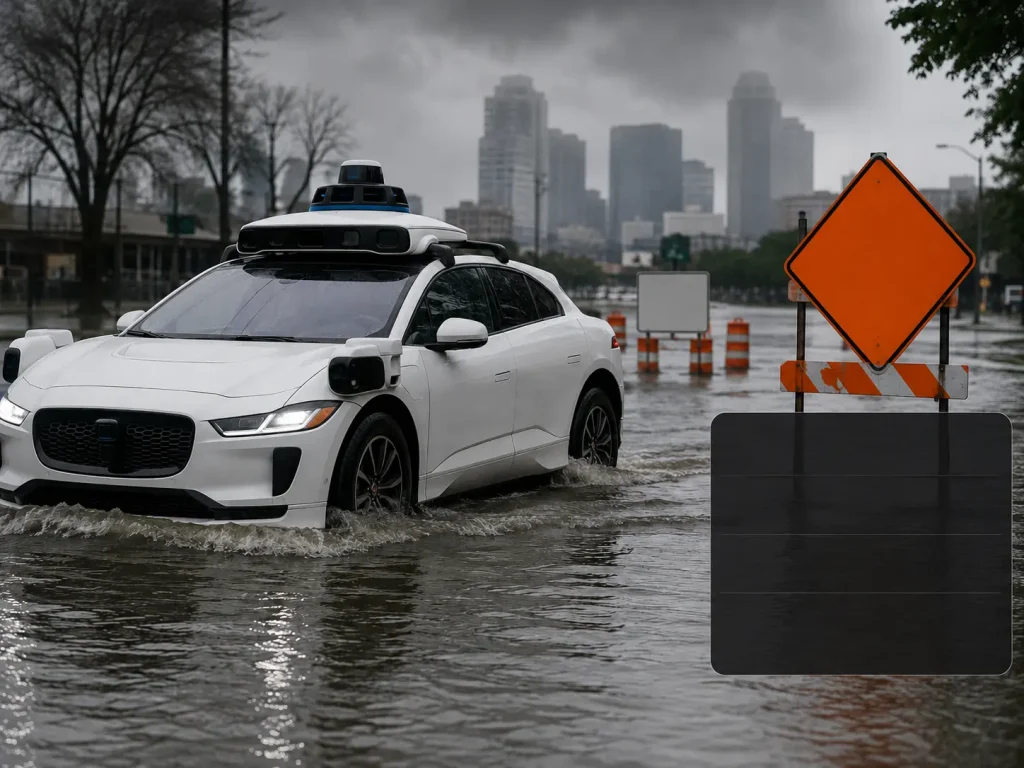
Self-driving taxi services have been temporarily paused in several US cities after safety concerns emerged around how some autonomous vehicles responded to flooded roads. The decision follows incidents where driverless vehicles entered standing water, became stuck, or faced dangerous road conditions during heavy rain.
The pause affects five cities, including four in Texas and one in Georgia. The move is being described as a precaution while engineers work on improving how the vehicles detect and respond to flooding, road hazards, and difficult weather conditions.
Although autonomous vehicle companies continue to promote driverless transport as a major step forward for urban mobility, recent incidents have reminded the public that safety challenges still exist. Flooded roads, construction zones, power outages, and traffic disruptions all create real-world situations that self-driving systems must handle reliably before widespread public trust can grow.
Why Robotaxi Services Were Temporarily Paused
The latest concern began after a driverless vehicle entered a flooded roadway in Texas. The vehicle was reportedly empty at the time, but it was swept into a creek after driving into water-covered road conditions. While no passenger injury was involved, the incident raised serious questions about how autonomous driving software interprets flooded roads.
Soon after, another driverless taxi was reported stuck in floodwater in Georgia. As a result, the company expanded its temporary service pause across five cities. The decision was made to reduce risk while the issue is reviewed and updated safety measures are developed.
Flooded roads are especially dangerous because standing water can hide road edges, potholes, curbs, drainage problems, or fast-moving currents. Even human drivers are often advised not to enter flooded areas because water depth can be difficult to judge. For autonomous vehicles, the challenge is even more complex because the car must rely on sensors, mapping, prediction systems, and software decisions in real time.
Software Issue Linked to Standing Water
The safety issue appears to involve how some autonomous vehicles behave when they encounter standing water on higher-speed roads. According to regulatory documents, the software problem could allow vehicles to slow down and then continue driving into water instead of stopping or avoiding the area.
This type of behavior is concerning because a vehicle may recognize an obstacle or road condition but still make an unsafe decision about whether to proceed. In heavy rain or flood-prone areas, that could increase the chance of the vehicle becoming disabled, blocking traffic, or entering a hazardous zone.
In response, the company issued a voluntary recall affecting thousands of vehicles using its newer automated driving systems. The recall is focused on software improvements rather than a traditional mechanical defect. Additional safeguards are also being developed to help the vehicles respond more safely when water is detected on the road.
Safety Remains the Main Focus
The company has said safety remains its highest priority and that it is monitoring weather forecasts, road alerts, and live conditions. Services are expected to resume once the company is confident that the vehicles can operate safely in affected areas.
Temporary pauses are not unusual in the autonomous vehicle industry. Because driverless technology depends on software, mapping, sensors, and constant testing, companies often adjust operations when new risks appear. However, these pauses can still affect public confidence, especially when incidents happen in busy cities or during severe weather.
For passengers, the most important question is simple: can a self-driving taxi make safe decisions in unpredictable conditions? The answer must be proven through real-world performance, not just controlled testing.
Freeway Services Also Suspended in Some Cities
In addition to the flooded road issue, the company has also temporarily suspended some freeway operations in several major US markets. This step is connected to how autonomous vehicles perform in construction zones.
Construction areas can be difficult for self-driving cars because lane markings may change, cones may replace painted lines, workers may move near traffic, and temporary signs may conflict with older map data. Human drivers often rely on judgment, eye contact, and flexible decision-making in these situations. Autonomous systems must be trained to process the same complexity safely and quickly.
The company has indicated that freeway routes are expected to return after further evaluation and improvements. Still, the decision shows how carefully driverless vehicle services must be managed as they expand beyond simple city routes.
Growing Concerns Around Driverless Vehicle Reliability
Over the past year, several driverless car incidents have increased public debate about autonomous vehicle safety. Some problems have involved vehicles stopping unexpectedly, becoming trapped, blocking streets, or struggling during unusual traffic conditions.
In one major city, a large power outage reportedly caused multiple driverless taxis to stop operating, leading to disruption across local roads. In another case outside the United States, a robotaxi outage caused many autonomous cars to stop in traffic at the same time.
These events do not necessarily mean driverless cars are unsafe overall. However, they highlight the importance of strong backup systems, weather awareness, remote support, and clear emergency procedures. A single vehicle stopping may be manageable. A large number of vehicles failing at once can create wider traffic problems.
What This Means for the Future of Robotaxis
The temporary pause shows that autonomous vehicle technology is still developing. While driverless taxis can already complete large numbers of rides in several cities, difficult conditions remain a major test.
Flooding is a particularly important challenge because climate-related extreme weather is becoming more common in many regions. Urban transport systems, including autonomous fleets, must be able to handle sudden storms, poor visibility, blocked roads, and emergency alerts.
For robotaxis to become a normal part of daily transport, companies need to prove they can manage more than routine trips in good weather. They must also show strong performance during unexpected events, including road closures, accidents, floods, construction zones, and system-wide disruptions.
Public Trust Depends on Transparency
Public confidence in autonomous vehicles depends heavily on transparency. When incidents occur, people want to know what happened, why it happened, and what steps are being taken to prevent it from happening again.
Voluntary recalls, temporary pauses, and software updates can be positive signs when handled responsibly. They show that a company is willing to act before a bigger problem develops. However, repeated incidents can also make riders and regulators more cautious.
Clear communication with passengers, local governments, and safety agencies will remain essential as robotaxi services expand into more cities.
A Careful Step Back Before Moving Forward
The decision to pause robotaxi operations in five US cities is a reminder that self-driving technology must earn trust through consistent safety. Entering flooded roads is a serious issue, even when no passengers are inside the vehicle.
Autonomous vehicles may still play a major role in the future of transport, but progress must be matched with careful testing and fast safety improvements. For now, the temporary pause gives engineers time to strengthen the software, improve flood detection, and make sure driverless taxis are better prepared for challenging road conditions.
In the long run, the success of robotaxi services will depend not only on innovation, but also on reliability, accountability, and the ability to handle real-world roads safely in all conditions.
