


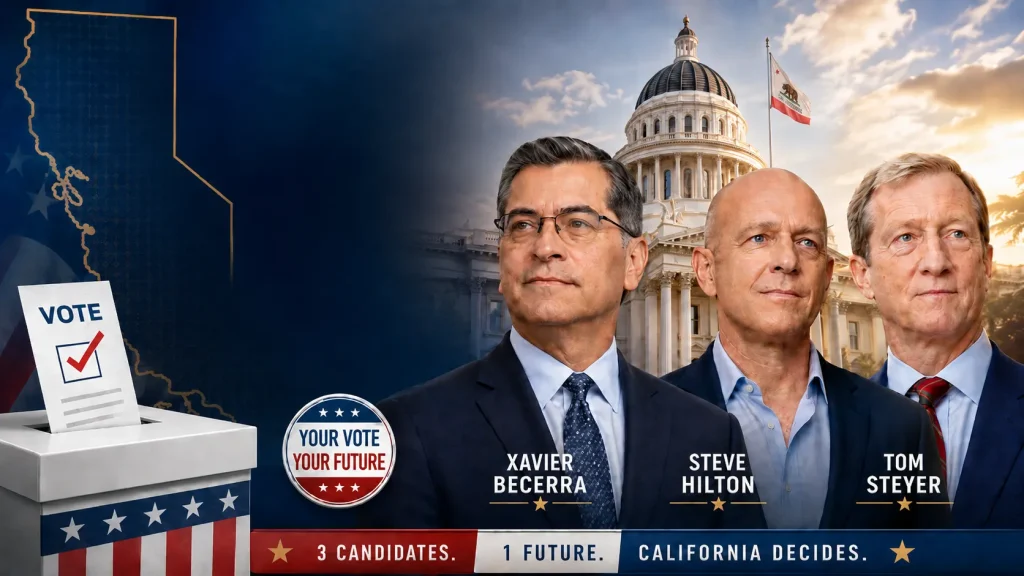
California’s latest primary election has become one of the most closely watched political contests in the United States. The governor’s race remains too close to call as early results show a tight competition between leading candidates from both major political sides. With many ballots still left to be counted, the final outcome may take time to become clear.
The race is especially important because California is preparing to choose a new governor after the current governor reaches the end of his term. As one of the largest and most influential states in the country, California’s political direction often receives national attention. This year’s primary has attracted even more interest because of the large number of candidates, voter frustration over major state issues, and uncertainty about who will advance to the general election.
Early results show Steve Hilton, Xavier Becerra, and Tom Steyer among the leading names in the race. However, the situation remains fluid because California often takes time to count mail-in ballots. In a state where many voters prefer voting by mail, early results do not always show the complete picture. As more ballots are verified and counted, the order of candidates could still change.
A Crowded and Unpredictable Race
One of the biggest reasons this election has become so unpredictable is the large number of candidates on the ballot. Dozens of people entered the governor’s race, making it difficult for voters to focus on one clear frontrunner. The crowded field also created a challenge for political parties, especially because support was divided among several well-known and lesser-known candidates.
California uses a primary system where all candidates appear on the same ballot, regardless of party. Under this system, only the top two vote-getters move forward to the general election. This means two candidates from the same party can advance, while others may be left out even if their party has strong statewide support.
This system made the election more uncertain. Many voters were concerned that a divided field could affect the final result. In particular, when several candidates from the same political side compete against each other, they can split the vote. That creates the possibility of unexpected results, especially in a race with so many names on the ballot.
Early Leaders and Their Campaign Messages
Steve Hilton emerged as one of the early leaders in the race. He focused much of his campaign on criticism of California’s current political leadership. His message appealed to voters who feel the state has not done enough to solve problems such as high living costs, homelessness, public safety concerns, and housing affordability. His campaign presented him as an outsider who could challenge the existing political system.
Xavier Becerra also became a major contender after gaining momentum in the later stages of the campaign. His campaign focused on experience, public service, and knowledge of government. He presented himself as someone who understands how institutions work and how to manage complex public issues. For voters looking for stability and administrative experience, this message appeared to connect strongly.
Tom Steyer, another leading candidate, ran with a message focused on progressive change, climate issues, economic fairness, and reform. His campaign positioned him as someone willing to challenge wealthy interests and push for major policy changes. Although critics questioned his heavy personal spending, his supporters saw him as a candidate with the resources and independence to compete in a difficult race.
The competition between these candidates shows the wider divide among voters. Some want experienced leadership. Others want a major change in direction. Many simply want practical solutions to problems affecting daily life in California.
Why Ballot Counting May Take Time
The final result may not be clear immediately because California has a detailed ballot-counting process. Mail-in ballots must be received, verified, and counted carefully. This process can take several days or even longer, depending on how many ballots remain.
In recent elections, many voters have chosen to mail their ballots or drop them off close to election day. That means early results may reflect only part of the vote. Candidates who appear ahead on election night can sometimes lose ground as later ballots are counted. For this reason, several campaigns have urged patience and said they will wait until all votes are included before making final claims.
This slow counting process can create uncertainty, but it is also part of the state’s effort to make sure ballots are properly verified. In close elections, even small shifts in vote totals can change which candidates advance to the general election.
Key Issues Driving Voter Decisions
The California governor’s race has been shaped by several major issues. Housing affordability remains one of the biggest concerns for voters. Many residents feel that buying or renting a home has become increasingly difficult, especially in major cities and coastal areas. Rising rents, limited housing supply, and high property prices have made this issue central to the campaign.
Homelessness is another major concern. Voters across the state have expressed frustration over visible homelessness, public safety challenges, and the need for better housing and mental health support. Candidates have offered different approaches, but the issue remains one of the most difficult problems facing California.
The cost of living has also played an important role. Many families are struggling with high prices for food, fuel, utilities, and other daily needs. Even though California has a large economy, many residents feel that economic pressure has increased. This has created demand for leaders who can address affordability in a realistic way.
Wildfire risk and disaster response are also important topics. California has faced repeated wildfire emergencies, and voters want stronger planning, faster response, and better protection for communities. Climate concerns, infrastructure, and emergency management have all become part of the political debate.
Political Uncertainty in a Strongly Democratic State
California is often seen as a strongly Democratic state, but this race has shown that political outcomes can still be complicated. A large field of candidates, voter dissatisfaction, and the state’s open primary system have made the race more competitive than many expected.
Some voters are frustrated with one-party dominance and want a stronger challenge to the current leadership. Others still prefer Democratic leadership but are divided over which candidate best represents the future of the state. This divide has made it difficult for one candidate to build a clear lead.
The lack of a single dominant candidate also reflects a wider political mood. Many voters appear uncertain about which direction California should take next. Some want experienced government leadership, while others want bold reforms or a complete change in style.
Los Angeles Mayoral Race Adds More Attention
Alongside the governor’s race, the Los Angeles mayoral race also attracted attention. The incumbent mayor advanced to the general election, but the contest showed signs of voter dissatisfaction. Challenges related to homelessness, wildfire response, public safety, and city management became important campaign themes.
The mayoral race matters because Los Angeles is the largest city in California and one of the most influential cities in the country. Political problems in Los Angeles often reflect broader issues across the state. The results suggest that voters are closely watching how leaders respond to daily challenges affecting residents.
A strong challenge from outside traditional political circles also showed that some voters are open to unconventional candidates. This trend is not limited to California. Across the country, voters have shown interest in candidates who present themselves as outsiders or critics of the political establishment.
What Happens Next
The next stage depends on the remaining vote count. Once all ballots are processed, the top two candidates in the governor’s race will move forward to the general election. Until then, campaigns will continue watching the numbers closely.
If the early leaders maintain their positions, the general election could become a major contest between different visions for California. The campaign may focus heavily on affordability, homelessness, public safety, wildfire planning, taxation, and the future of state government.
The final matchup will also influence national political discussion. Because California is such a large and economically powerful state, its elections are often seen as indicators of broader public sentiment. The governor’s race may offer clues about voter frustration, party loyalty, and the appeal of outsider candidates.
California Primary Election: Close Governor’s Race
California’s primary election has delivered a dramatic and uncertain governor’s race. With many ballots still uncounted, the final outcome remains unclear. Early results show a close contest among major candidates, but the state’s mail-in voting process means the race could still shift.
The election reflects deep voter concern about housing, homelessness, affordability, public safety, and leadership. It also shows how a crowded field and open primary system can create unpredictable political results.
As California waits for the final count, one thing is clear: the race for governor will remain one of the most important political stories of the year. The candidates who advance to the general election will face the challenge of convincing voters that they can solve the state’s biggest problems and guide California through a period of uncertainty and change.
