


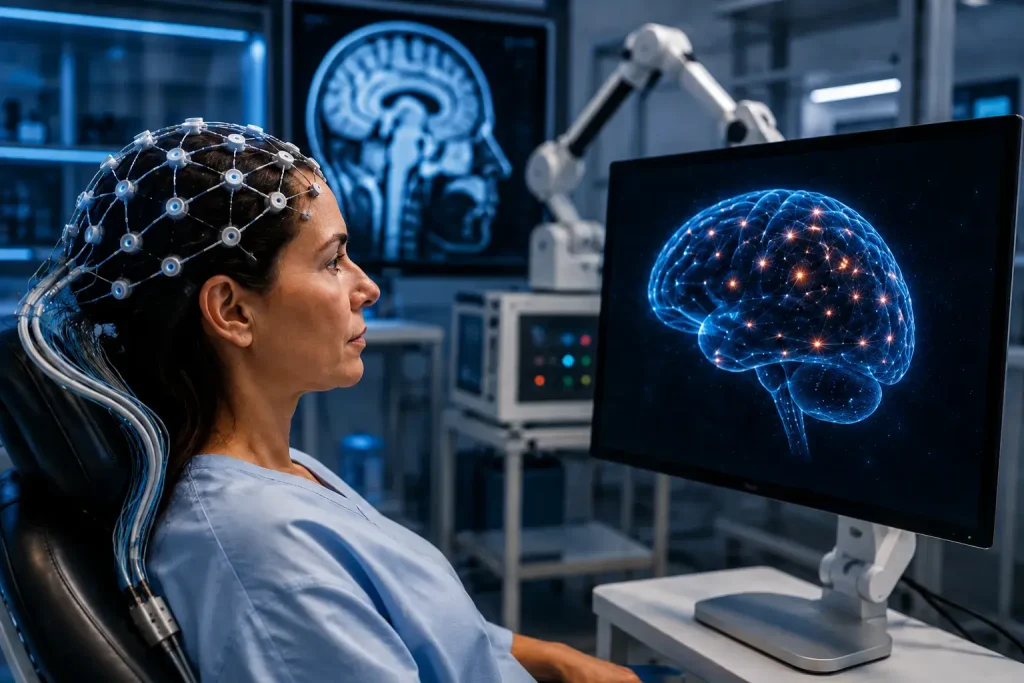
Artificial intelligence is helping scientists move closer to a future where brain activity can be translated into words, images and even sound. What once seemed like science fiction is now becoming a serious area of medical and technological research.
Recent studies have shown that computers can decode signals from the brain and turn them into text. The technology is especially important for people who cannot speak because of paralysis, stroke, motor neurone disease or other serious conditions that affect communication.
Researchers are still far from reading someone’s private thoughts perfectly. However, the progress being made in brain-computer interfaces is giving scientists a clearer view of how the brain works and how technology might help people communicate again.
A New Step Toward Thought-Based Communication
One of the most striking examples involved a woman who had been unable to speak clearly after a stroke nearly two decades earlier. She was fitted with a small array of electrodes placed in the front part of her brain.
As she imagined saying words, a computer system used artificial intelligence to interpret her brain signals and display words on a screen. For someone who had lost the ability to speak naturally, the technology offered a new way to communicate.
The system did not work like magic. It required training, medical equipment and advanced computer models. But it showed that brain activity linked to speech can be decoded with increasing accuracy.
What Are Brain-Computer Interfaces?
Brain-computer interfaces, also known as BCIs, are systems that connect the brain directly with a computer or machine. They read brain signals and use software to change those signals into useful commands.
In earlier research, BCIs were mainly tested for simple tasks, such as moving a cursor on a screen or helping someone control an artificial limb.
For example, some BCI systems allowed users to move a cursor on a screen, while others helped control a prosthetic arm or other assistive device.
. These systems focused mainly on movement signals from the brain.
Decoding speech is more difficult. Speech involves language, sound patterns, timing, intention and meaning. For years, researchers found it much harder to translate speech-related brain activity than movement-related signals.
Artificial intelligence is now helping to change that. Machine learning systems can analyse large amounts of complex brain data and identify patterns that would be extremely difficult for humans to detect manually.
How AI Helps Decode Brain Signals
The human brain is always sending electrical signals. These signals are very detailed and can change depending on what a person is thinking, trying to do, or trying to say.
In speech-related brain-computer interface systems, electrodes pick up activity from the parts of the brain that help with speech planning and movement. AI then studies these signals and learns to spot patterns that may be linked to sounds, words, or speech movements.
The computer is not listening to a person’s voice like normal speech software. Instead, it reads the brain’s activity and tries to understand what the person wants to say.
The idea is similar to speech recognition, but the input is different. Speech recognition works with sound, while this technology works with brain signals.
From Attempted Speech to Inner Speech
Many early speech-decoding systems required users to attempt to speak. Even if they could not move their mouth or produce clear sound, they had to mentally try to say the words.
This approach can work, but it can also be tiring. Attempted speech still requires effort, especially for people with serious physical limitations.
Researchers are now exploring whether technology can decode inner speech. Inner speech is the voice people hear in their own mind when they silently think through words or sentences.
In recent experiments, scientists asked participants to imagine words or complete mental tasks that encouraged silent counting. The system was able to pick up some traces of this inner speech.
The results were not perfect. Accuracy was higher in controlled tasks and lower when participants were asked to think freely. Still, the findings suggest that inner speech may leave detectable patterns in the brain.
Why This Matters for People Who Cannot Speak
The most immediate benefit of this technology is medical. People who are paralysed, have severe speech disorders or live with conditions such as ALS could one day use BCI systems to communicate more naturally.
For someone who cannot speak, typing with eye movement or other assistive tools can be slow and exhausting. A brain-based communication system could make conversation faster and easier.
Some experiments have already shown that speech BCIs can produce words at meaningful speeds. Although they are still slower than normal speech, they are improving.
Natural human conversation is fast, emotional and expressive. Researchers are now working not only on decoding words, but also on capturing tone, rhythm, pitch and emphasis.
Communication Is More Than Text
Human speech is not only about the words people say. Meaning often comes from how words are spoken. A question, a joke, a warning or an emotional statement can all sound different even if the words are simple.
Researchers have begun testing systems that can decode non-verbal features of speech. These include pitch, speed, rhythm and intonation.
This could eventually allow a person using a brain-computer interface to communicate with more emotion and personality. Instead of producing flat text on a screen, the system could generate speech that sounds more natural.
There is still a long way to go, but this area of research could make future assistive technology feel more human.
Better Devices Could Improve Accuracy
Current systems often record signals from a very small number of neurons compared with the billions found in the human brain. That limits how much information can be captured.
Scientists believe that future devices with more electrodes and better sensors could collect richer brain data. This could improve speed, accuracy and reliability.
The placement of electrodes is also important. Many current systems focus on the motor cortex, the part of the brain involved in movement. But researchers are also studying other areas that may be involved in hearing, language and inner speech.
Understanding these areas could help people whose motor cortex has been damaged by stroke or injury.
AI Is Also Reconstructing Images From Brain Scans
AI is being used for more than speech research. Some scientists are now looking at whether brain scans can show what a person has seen, or even what they are imagining.
In these tests, a person looks at different pictures while their brain activity is recorded. The AI studies that activity and then tries to make an image from the signals.
The recreated images are still not completely accurate. In some cases, though, they can give a rough idea of what the person saw, such as the main shape, layout, or general concept.
This research is helping scientists understand how the brain processes visual information. Different regions appear to handle different parts of vision, such as colour, layout and object meaning.
Decoding Music and Sound
Scientists are also trying to reconstruct audio experiences from brain activity. Music is especially difficult because it changes continuously over time.
Unlike a still image, a song has rhythm, melody, pitch and emotion moving together. Brain scans also have limits in how quickly they can capture changes.
Even so, researchers have made progress in identifying the general character of music from brain activity. These studies could improve understanding of how the brain processes sound, memory and emotion.
The research is still early, but it shows how quickly the field is expanding beyond basic speech decoding.
The Promise and the Concerns
AI brain technology has huge potential, especially for healthcare. It could help people who have lost the ability to speak, move or interact with the world in normal ways.
At the same time, the technology raises serious questions. Brain data is deeply personal. If machines become better at decoding thoughts, privacy and consent will become major concerns.
Researchers are clear that today’s technology cannot read anyone’s mind freely or perfectly. Most systems require medical equipment, training and controlled conditions.
Still, as the technology improves, rules and ethical safeguards will be important. People will need confidence that brain data is protected and used responsibly.
Commercial Use May Be Coming
Several companies and research groups are working to move brain-computer interfaces from laboratories into real-world use. The first major applications are likely to focus on medical needs.
People with paralysis or serious communication problems may be among the first to benefit from this technology. Before it becomes available for wider use, commercial systems will still need to show that they are safe, dependable, and practical in real life.
Brain implants can provide detailed signals, but they require surgery, which means they may not be suitable for every patient. Non-invasive methods, such as external brain scanning, are generally safer, but they may not capture the same level of detail.
In the future, both methods may be used in different situations. The choice will likely depend on the patient’s condition, the medical purpose, and how much detail the system needs from the brain signals.
A New Window Into the Brain
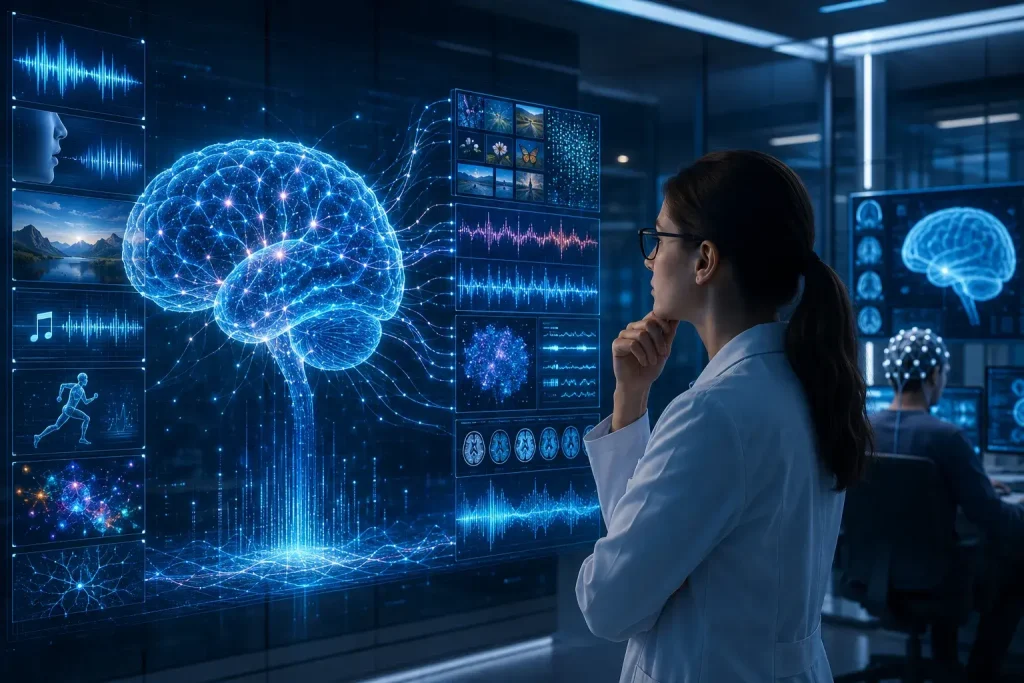
One of the biggest benefits of this research is that it gives scientists a clearer view of how the brain works. With AI studying neural signals, researchers can look more closely at how the brain handles speech, images, sound, and thought.
This does not mean computers can fully understand the human mind. They are not reading consciousness. But they are helping scientists notice patterns in brain activity that were very difficult to study before.
As decoding technology improves, researchers learn more about how the brain stores information, processes it, and turns it into speech, movement, or visual ideas. In that sense, this research is not only about building new tools, but also about understanding the brain itself.
AI Opens a New Window Into the Human Brain
AI brain technology is changing how scientists study the brain and how people may communicate in the future. Systems that can turn brain signals into text, speech, images, or sound could make a real difference for people who cannot speak or communicate in the usual way.
The technology is still at an early stage, and there are important issues to solve. Researchers will need to improve accuracy, protect privacy, make the systems safe, and ensure the technology can be used by the people who need it most.
For now, AI cannot read minds in the way people might imagine from science fiction. But it is helping scientists decode parts of brain activity that were once almost impossible to understand. In the years ahead, that progress could change how people communicate, recover and connect with the world around them.
