


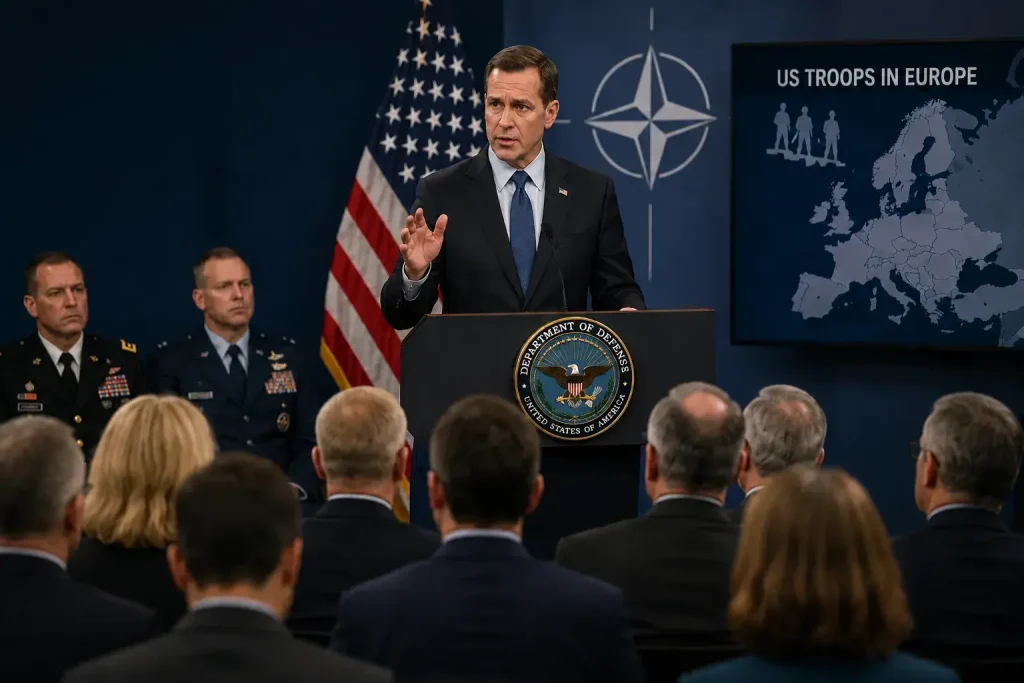
A senior US official has acknowledged that European allies may feel uneasy about Washington’s plans, but said they already understand the direction the US is considering.
He said that while European countries may not welcome the move, they are aware of the discussion taking place.
US Military Presence in Europe Under Review
The United States remains the most powerful and capable member of Nato, the Euro-Atlantic security alliance that includes Canada and 30 European countries. For decades, the US has kept military forces across Europe as part of its defence commitments. These deployments were originally built as a deterrent during the Cold War period, when the main concern was the Soviet Union.
Since Russia’s full-scale invasion of Ukraine in February 2022, European allies have repeatedly urged Washington to stay committed to Europe’s security. Many governments see the American military presence as an important part of Nato’s defence strength.
Where US Troops Are Stationed in Europe
Germany hosts the largest number of US troops in Europe, with more than 36,000 active-duty personnel stationed there. Italy has around 12,000 US troops, while the UK has about 10,000. Poland is also believed to host nearly 10,000 American troops.
These deployments have long been seen as a key part of Nato’s deterrence strategy, especially as security concerns in Europe have grown in recent years.
Trump’s Criticism of Nato Spending
The US president has often criticised Nato, arguing that European allies and Canada have not contributed enough financially compared with Washington. At different times, he has also suggested that the US could reconsider its role in the alliance if other members do not increase defence spending.
In response to growing pressure, several Nato countries have now agreed to raise their military budgets.
Iran Conflict Adds New Pressure on Alliance
However, tensions have increased further after Nato members declined to support the US in its conflict with Iran. This has added to frustration inside the White House and strengthened calls for Washington to review its defence commitments overseas.
The issue has created another point of disagreement between Washington and some of its European partners.
America First Policy Shapes Troop Reduction Plans
In recent weeks, the White House has indicated that it wants to lower the overall number of US troops in Europe as part of its wider “America First” policy. The plan appears to fit with a broader strategy of reducing American military responsibilities abroad and pushing European allies to take more responsibility for their own defence.
Nato’s secretary general has also said that Europe’s move toward becoming less dependent on the United States is likely to continue.
Rubio Says Nato Must Also Benefit the US
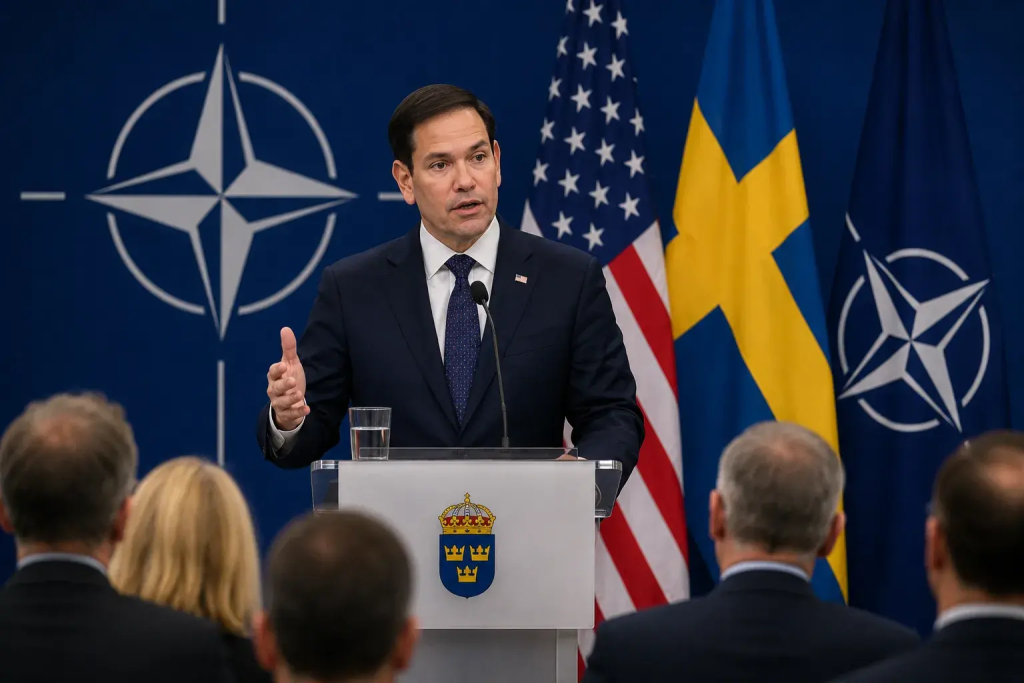
During remarks in Sweden, the US secretary of state said there has always been debate in American politics over how much the United States should contribute to the Euro-Atlantic alliance.
He said Nato must not only be valuable for Europe, but also for the United States. According to him, the alliance needs to serve American interests as well as European security needs.
What This Means for Nato’s Future
The comments come at a sensitive time for Nato, as the alliance faces pressure from Russia’s war in Ukraine, rising defence costs, and growing political debate in Washington about America’s global military role.
Any reduction in US troop numbers would likely be closely watched by European governments, especially those near Russia’s borders. For now, the debate shows that Nato’s future may depend not only on military strength, but also on how responsibility is shared between the United States and its allies.
