


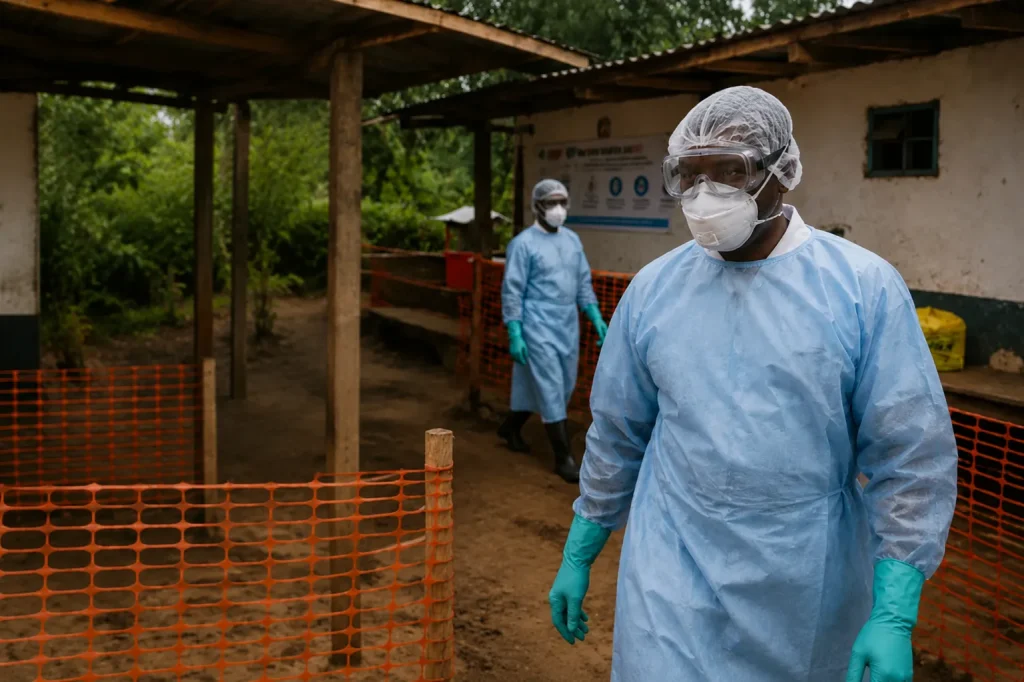
The public health risk linked to the latest Ebola outbreak in the Democratic Republic of Congo has been raised to “very high” at the national level, according to the global health agency.
Health officials said the situation inside DR Congo has become more serious, while the wider regional risk remains high. At the global level, however, the risk is still considered low.
The outbreak involves the Bundibugyo strain of Ebola, a rare form of the virus for which there is currently no proven vaccine. This strain is known to be deadly, with around one in three infected people at risk of death.
So far, the outbreak has been centred in DR Congo, where hundreds of suspected cases and deaths have been reported. Officials have said there are 750 suspected cases and 177 suspected deaths connected to the outbreak.
Rare Ebola Strain Raises Concern
Ebola is a rare but dangerous viral disease. It can spread through contact with infected body fluids and can cause severe illness, including fever, weakness, vomiting, bleeding, and organ complications.
The Bundibugyo strain is less common than some other Ebola species. Because of its rarity, health teams have fewer tested tools available to control it quickly.
Ebola viruses are usually found in animals, especially fruit bats. Human outbreaks can begin when people come into contact with infected animals, including through handling or eating contaminated animal meat.
Vaccine Work Is Moving Forward
Scientists in the UK are working on a possible vaccine for the Bundibugyo strain. The vaccine is still under development and could be ready for early clinical testing within two to three months.
The vaccine is being built using technology that was previously used in Covid vaccine research. However, researchers have warned that there is no guarantee it will work. It will first need to pass animal studies and then be tested in people before its effectiveness can be confirmed.
Animal testing is already understood to be under way. If the vaccine candidate progresses successfully, a major vaccine producer is expected to support large-scale production once suitable medical-grade material is available.
A separate experimental vaccine for the Bundibugyo strain is also being developed, but it may take six to nine months before doses are ready for testing.
Health research officials have described one of the vaccine candidates as especially promising, comparing its potential role to an existing Ebola vaccine used against a more common strain of the virus.
Confirmed Cases and Regional Risk
During a briefing in Geneva, health officials said the risk assessment had been revised because of the seriousness of the outbreak.
The risk is now considered very high inside DR Congo, high across the wider region, and low globally.
Officials also reported that 82 cases have been confirmed in DR Congo, including seven confirmed deaths.
In neighbouring Uganda, the situation has been described as stable. Two confirmed cases of the Bundibugyo strain and one death have been reported there. Both confirmed cases were linked to people who had travelled from DR Congo.
Emergency Declared, But Not a Pandemic

A public health emergency of international concern has been declared because of the outbreak. However, health officials have made clear that the situation is not being described as a pandemic.
The emergency declaration is intended to support stronger international coordination, faster response efforts, and better access to medical resources in affected areas.
Health teams are working to trace contacts, isolate suspected cases, support treatment centres, and reduce the risk of further transmission.
Insecurity Makes Response More Difficult
The response to the outbreak has been complicated by violence and insecurity in parts of eastern DR Congo. Some confirmed cases have been reported in areas controlled by armed groups, making it harder for health workers to reach affected communities safely.
Health officials have warned that public trust is essential during an Ebola outbreak. Without trust, communities may resist isolation measures, safe burial procedures, or medical treatment.
The situation became more tense after angry relatives reportedly attacked a hospital in eastern DR Congo. The incident happened after health workers refused to release the body of a patient because of the risk of contamination.
A local official said people began throwing objects at the hospital and later set fire to tents being used as isolation wards. Police fired warning shots to disperse the crowd during the unrest.
Trust Remains Key to Controlling the Outbreak
Health experts say controlling Ebola depends not only on medical treatment and vaccines, but also on cooperation from affected communities.
Safe burials, early reporting of symptoms, isolation of suspected cases, and contact tracing are all important steps in stopping the virus from spreading.
The latest outbreak in DR Congo remains a serious concern for national and regional health authorities. While the global risk is still low, officials say urgent action is needed to contain the virus, protect health workers, and build public trust in areas affected by the outbreak.
