


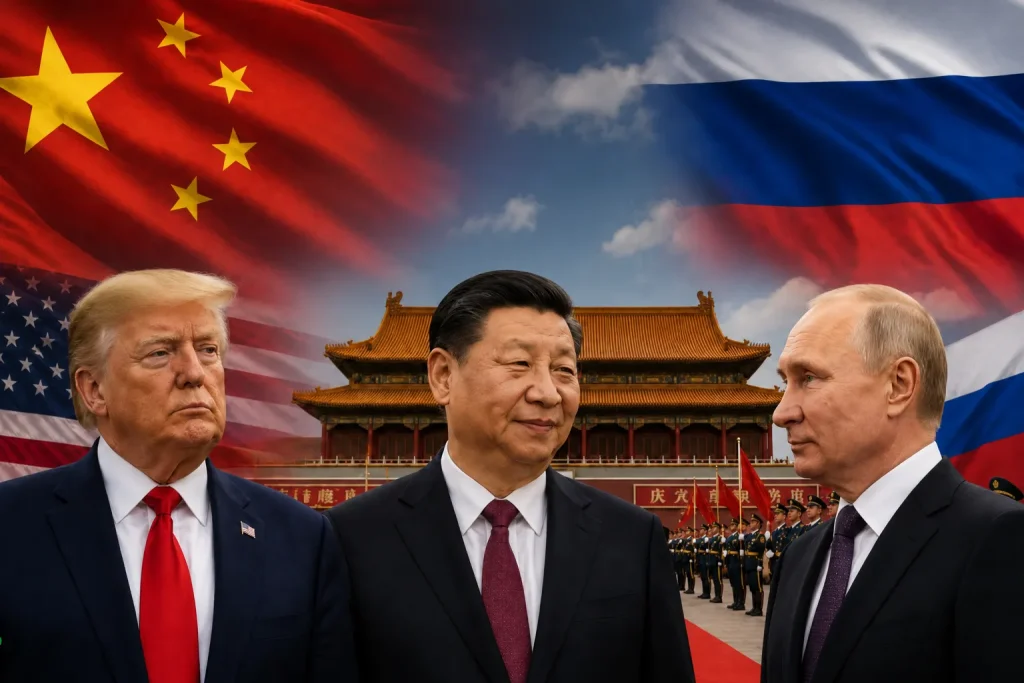
Chinese President Xi Jinping has placed himself firmly in the diplomatic spotlight after hosting Russian President Vladimir Putin in Beijing only days after welcoming Donald Trump. The two high-profile visits have given China an opportunity to present itself as a central player in global politics, able to speak with rival powers while avoiding firm alignment with any single side.
Putin’s reception outside the Great Hall of the People carried all the signs of a major state welcome. There were cheering children, a military honour guard, cannon fire and a marching band. The scene looked very similar to the ceremony held for Trump just days earlier. For Beijing, that similarity was important. It sent a message that China is now a destination where world leaders come to talk, negotiate and be seen.
Beijing Presents Itself as a Global Power Centre
The timing of the visits allowed Xi to project confidence both at home and abroad. China wants to show that its large economy, growing diplomatic network and strategic influence have made it unavoidable in world affairs.
Beijing’s message is simple: China is not isolated. Instead, it is positioning itself as a country that can engage with different sides, even when those sides are in conflict with each other. This approach allows China to keep relations open with Russia, maintain dialogue with the United States, and continue building trade ties with other parts of the world.
The image also supports Xi’s long-term vision of China’s rise. For years, he has spoken about national renewal and China’s return to a powerful role on the global stage. Hosting two major leaders within days helps strengthen that message for a domestic audience.
Similar Welcomes, Different Political Meaning
Although Putin and Trump received similar public receptions, the politics behind the two visits were very different.
Putin has visited China many times and is widely seen as having a close relationship with Xi. However, Russia’s position has changed since the invasion of Ukraine. Western sanctions and diplomatic isolation have made Moscow more dependent on Beijing than before.
China has become Russia’s most important trading partner and a major buyer of its oil and gas. This makes the relationship useful for both countries, but it is not equal. Russia needs China’s economic support, while China can use the relationship to strengthen its global position without fully taking responsibility for Russia’s actions.
During the talks, China and Russia agreed on more than 20 areas of cooperation, including trade and technology. However, there was still no final approval for a long-discussed gas pipeline that Moscow has been pushing for years. This showed that Beijing is willing to cooperate with Russia, but only on terms that serve Chinese interests.
Xi Holds Strong Cards in Global Talks
Xi also appeared to be in a strong position during discussions with Trump. China’s trade relationships, strength in manufacturing and dominance in rare earth minerals have given Beijing more leverage in talks with Washington.
Both Trump and Putin arrived in Beijing while facing pressure from long-running conflicts. Putin continues to deal with the heavy cost of the war in Ukraine, while Trump faces political pressure connected to conflict in the Middle East. In both cases, China appeared able to set the tone of engagement.
This gives Xi room to present China as a stable and patient power at a time when other major countries are dealing with crises. Beijing can use this position to strengthen its influence without becoming directly involved in every conflict.
China’s Diplomatic Turnaround
China’s current position marks a major shift from just a few years ago. During the pandemic, its borders were closed and relations with Western countries had become tense. Beijing faced criticism over human rights issues, Hong Kong, trade restrictions and its aggressive diplomatic style.
In recent years, China has tried to soften its approach. This change is partly practical. China’s economy has slowed, and Beijing needs foreign investment, trade and stable international relationships. A more confrontational style risked pushing important countries closer to Washington.
Since Trump returned to power, China has also worked to repair ties with several US allies, including Australia, Canada and the UK. Leaders from major economies have visited Beijing for talks, trade discussions and diplomatic meetings. This has helped China present itself as a power that others need to engage with.
A Difficult Balance Over Ukraine and the Middle East
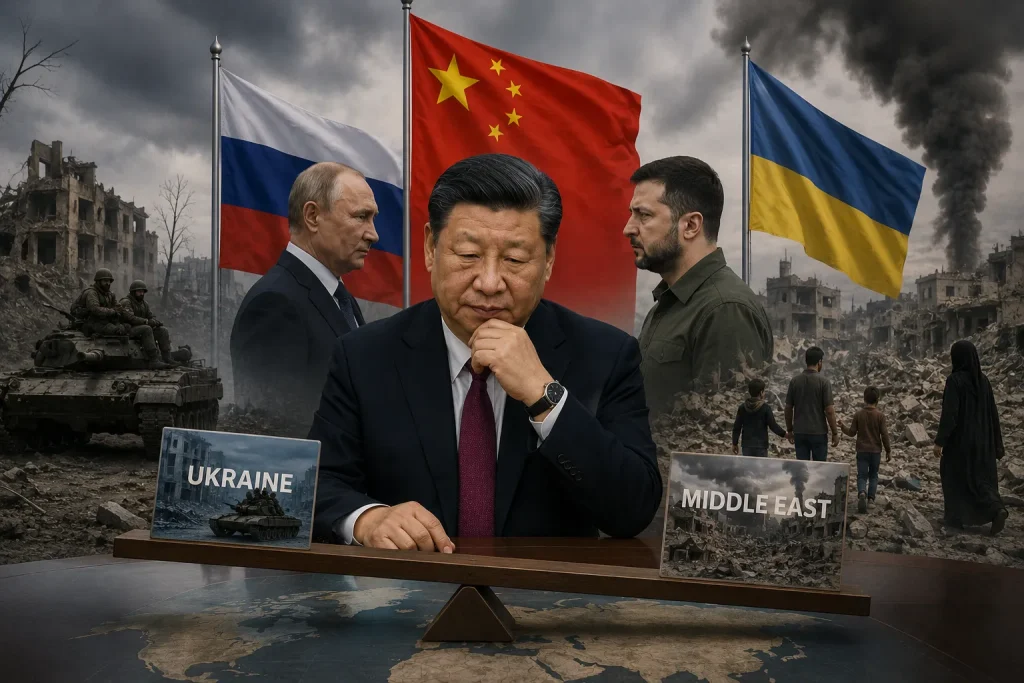
Despite the successful optics, China’s diplomatic role still faces serious limits. During his meeting with Putin, Xi spoke about the need to end conflict in the Middle East, but he avoided directly discussing Russia’s war in Ukraine.
This silence is likely to raise questions in Europe. China says it supports peace and stability, but its close relationship with Russia makes its position on Ukraine difficult. Western countries have urged Beijing to reduce the economic support that helps Moscow manage sanctions, but China has not taken a strong public stand against Russia.
China may fear that weakening Russia too much could create instability near its own borders. At the same time, avoiding criticism of Moscow can damage Beijing’s image as a fair global mediator.
Xi’s Global Role Still Faces Challenges
The visits by Putin and Trump have strengthened Xi’s image as a leader at the centre of global diplomacy. Beijing has shown that it can host powerful leaders, manage complex relationships and present itself as a major voice in world affairs.
However, influence is not the same as trust. Many countries still remain cautious about China’s political system, its close ties with Russia and its unclear position on major wars.
Xi may be enjoying the spotlight, but turning diplomatic theatre into lasting global leadership will be much harder. For China, the challenge is no longer just getting world leaders to visit Beijing. The bigger test is whether it can use that influence to solve real international problems.
