



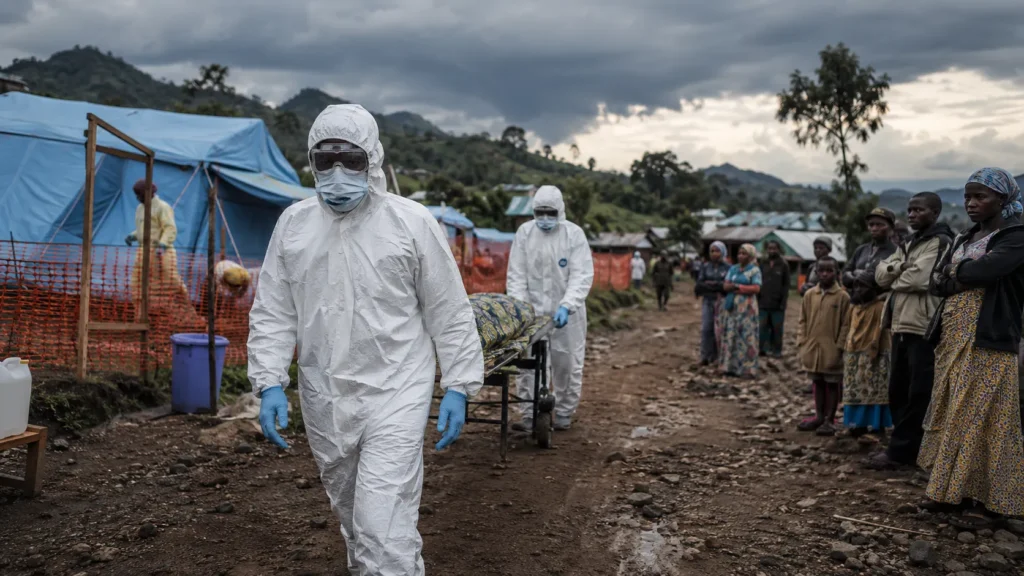
Things are taking a dark turn on the ground. The ongoing Ebola outbreak in DR Congo has forced international health experts to raise their national risk rating to “very high.” A briefing in Geneva made it clear that while the rest of the world isn’t in immediate danger, the threat level inside the Democratic Republic of Congo is critical. Neighboring African borders are also bracing for impact, with the regional risk now sitting at high.
What is driving this sudden panic? It turns out this specific Ebola outbreak in DR Congo is driven by the rare Bundibugyo strain. This isn’t the usual variant health teams are used to dealing with. The real problem is that there is absolutely no proven vaccine or solid treatment ready for it yet.
The numbers coming out of the region show how fast things are moving:
- Right now, local field teams are keeping an eye on 750 suspected cases and 177 suspected deaths.
- Out of those, labs have officially confirmed 82 cases and 7 deaths inside DR Congo.
- The virus has also managed to cross the border into Uganda, where 2 cases are confirmed, and 1 person has died—both patients had just traveled from the Congolese hotspot.
Even though the World Health Organization has declared this a “Public Health Emergency of International Concern,” officials are telling people not to panic. This is not a pandemic. The emergency declaration is just an official trigger to get international funding moving and push medical resources where they are needed most.
But getting those resources into the right hands is a logistical nightmare. The biggest roadblock is the active violence in eastern DR Congo. With several infected areas sitting right in territory controlled by rebel armed groups, doctors cannot do their jobs safely. On top of that, public trust has completely broken down. Just days ago, an angry crowd attacked a hospital and torched isolation tents in eastern DR Congo. The chaos started because medical staff refused to hand over a deceased patient’s body to prevent highly contagious fluids from spreading during a traditional burial. Police had to fire warning shots into the air to stop the riot, proving that fighting the virus is only half the battle.
The Biology Behind the Bundibugyo Strain
Ebola is a terrifying zoonotic disease. It usually hides in wildlife, particularly fruit bats, and then jumps to humans through infected bushmeat or close contact with bodily fluids.
Once it finds its way into a community, it spreads fast. The virus causes intense fevers, physical collapse, internal bleeding, and organ failure. The Bundibugyo strain is incredibly unforgiving: roughly one out of every three people who catch it ends up dying. Because outbreaks of this specific variant happen so rarely, global pharmaceutical companies have never finalized a vaccine for it. Now, health teams are paying the price for that gap.
Current Data: Outbreak at a Glance
| Location | Suspected Cases | Confirmed Cases | Confirmed Deaths | Local Risk Status |
| DR Congo (Epicenter) | 750 | 82 | 7 | Very High |
| Uganda (Border Zone) | Few | 2 | 1 | High (Stable) |
| Global Communities | 0 | 0 | 0 | Low |
The Vaccine Pipeline: Quick Breakdown
- The UK Candidate (Fast-Track)
- Platform: Built on the exact same technology platform as the COVID-19 vaccines.
- Current Status: Undergoing animal trials.
- Human Testing: Expected to start within 2 to 3 months if successful.
- Scaling: A major drug manufacturer is already prepared to scale up mass production.
- The Secondary Candidate (Backup Formula)
- Platform: Developed in a different lab using a slower, traditional method.
- Field Ready: Will take at least 6 to 9 months before doses can be used in real-world field trials.
The Real Crisis: Insecurity and Broken Trust
The tragic truth about the Ebola outbreak in DR Congo is that medical science cannot solve this alone. The virus is thriving because of a geopolitical mess. Eastern DR Congo has been trapped in militia warfare for decades. It is almost impossible to run contact tracing or keep people in isolation when health workers are actively dodging gunfire.
Field Note: Misinformation is traveling much faster than the actual disease. Local communities, exhausted by years of war, are deeply suspicious of outsiders. When doctors try to enforce biohazard rules like stopping traditional hand-washing rituals on highly infectious bodies during funerals, it often sparks violent pushback.
If the international community wants to stop this outbreak, they have to focus heavily on local cultural diplomacy. Until the people on the ground trust that isolation wards are there to save lives rather than end them, the virus will keep spreading through the dark.

