



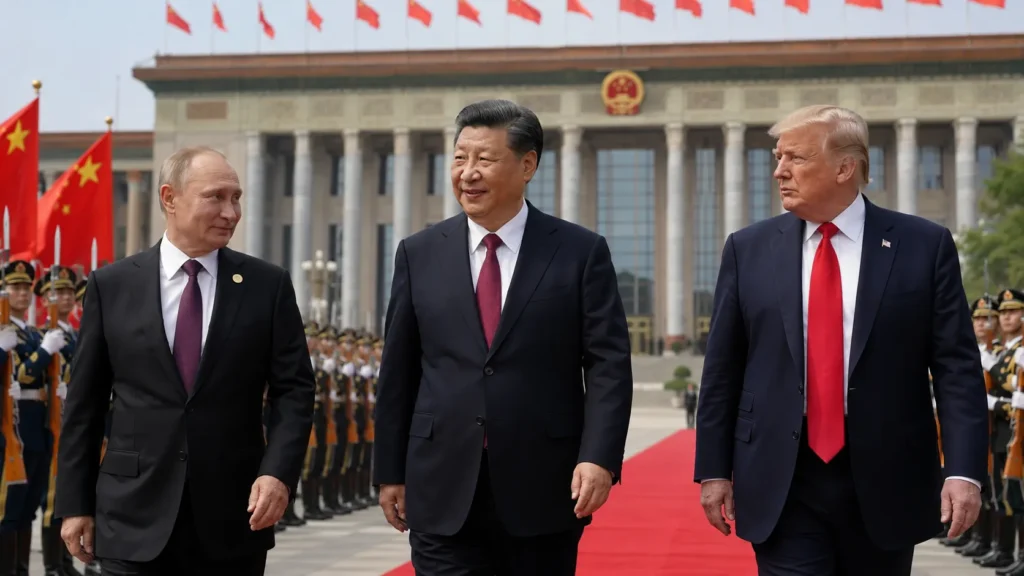
Xi Jinping is making it crystal clear who is driving world politics right now. Right after a massive summit with US President Donald Trump, Beijing rolled out the red carpet for Russian President Vladimir Putin. It is a brilliant balancing act. These back-to-back high-profile visits show the real weight of Xi Jinping global diplomacy. China isn’t just watching the global game anymore- it is running it.
The scene outside the Great Hall of the People said it all. Putin got the exact same grand welcome—military honor guard, marching band, the works-that Trump received just days ago. This matching treatment wasn’t an accident. Geopolitical experts see it as a direct message: Beijing is now the ultimate meeting point where global rivals have to come to talk business. Best of all for China? They get all this influence without signing any messy, permanent alliances.
Beijing Presents Itself as a Global Power Centre
The impeccable timing of these twin visits allowed President Xi Jinping to project immense confidence both to his domestic constituency and to international critics. Beijing’s current doctrine relies heavily on multi-alignment-the ability to maintain deeply functional relationships with opposing sides of major global conflicts.
- Strategic Multi-Alignment: China is successfully expanding trade corridors with Russia, keeping communication channels open with Washington, and simultaneously repairing economic ties with traditional US allies.
- Domestic Narrative Transformation: For the Chinese public, hosting the leaders of the world’s two other major nuclear powers back-to-back validates Xi’s core vision of “National Rejuvenation” and China’s return to its historical status as a central global power.
- Economic Inevitability: By leveraging its unparalleled manufacturing base and dominance over critical global supply chains, Beijing is demonstrating that no major global security or economic dispute can be effectively managed without Chinese participation.
Same Red Carpet, Radically Different Politics
While the public spectacles and welcoming ceremonies appeared identical on paper, the underlying geopolitical leverage and economic realities of the two bilateral relationships could not be more distinct.
The Sino-Russian Dynamic (The Transactional Axis)
Putin’s high-profile arrival emphasized Moscow’s escalating economic reliance on Beijing under the weight of severe Western sanctions. China has effectively become Russia’s economic lifeline, purchasing discounted oil and gas while supplying consumer and industrial goods. However, Beijing continues to prioritize its own national interests. Despite signing over 20 bilateral pacts on trade and technology, China notably withheld final approval for the long-delayed Power of Siberia 2 gas pipeline, underscoring that cooperation with Moscow will strictly be conducted on Beijing’s terms.
The Sino-US Dynamic (The Competitive Balance)
Conversely, the interaction with Donald Trump was an exercise in pure economic leverage. Armed with severe dominance in advanced manufacturing and global rare earth minerals extraction, Xi Jinping negotiated with Washington from a position of systemic trade strength.
Comparative Geopolitical Analysis: Beijing’s Twin Summits
| Strategic Attribute | Putin’s Visit (Russia) | Trump’s Visit (United States) |
| Bilateral Relationship Nature | Deepening strategic partnership driven by shared Western friction. | High-stakes technological and economic competition. |
| Beijing’s Core Leverage | High: Primary buyer of Russian energy exports and provider of dual-use technology. | High: Dominance in critical mineral refining and global manufacturing integration. |
| Primary Geopolitical Friction | Western pressure regarding secondary sanctions and indirect war support. | Aggressive tariff updates, trade deficits, and advanced semiconductor export bans. |
| Key Strategic Outcome | 20+ cooperation pacts finalized; Power of Siberia 2 pipeline delayed. | Direct re-engagement on trade stability and supply chain risk mitigation. |
China’s Tactical Diplomatic Turnaround
The calculated ease with which Beijing managed these competing world leaders represents a dramatic shift from its foreign policy posture just a few years ago. During the pandemic era, China faced mounting international isolation, an internal economic deceleration, and severe global backlash against its aggressive “Wolf Warrior” diplomacy.
Recognizing that an overly confrontational approach was actively driving European and Asian markets closer to Washington’s security umbrella, Beijing has implemented a pragmatic shift. In a targeted effort to attract foreign direct investment (FDI) and stabilize its economy, China has systematically repaired ties with key Western-aligned states, including Australia, Canada, and the United Kingdom.
The Strategic Limits of Beijing’s Neutrality
Despite the flawless diplomatic theater, the structural reach of the Xi Jinping global diplomacy influence faces rigid boundaries, particularly concerning active theater wars.
Expert Geopolitical Insight: “While President Xi openly used his joint press conference to champion peace initiatives in the Middle East, he remained entirely silent on Russia’s offensive in Ukraine. This selective diplomacy is drawing sharp skepticism from European capitals, who view China’s neutrality as a convenient shield for economic pragmatism.”
This calculated geopolitical silence highlights Beijing’s deepest strategic dilemmas:
- The Fear of Regional Instability: A total collapse of the Russian state could trigger extreme instability right on China’s massive northern border, leaving Beijing isolated against a unified Western alliance.
- The Credibility Deficit: By refusing to actively deploy its substantial economic leverage to pressure Moscow toward an exit strategy in Ukraine, Beijing severely limits its ability to be accepted as a genuinely impartial, global peace mediator.
Ultimately, converting high-stakes diplomatic theater into enduring global authority remains Beijing’s unresolved test. The true measure of China’s global rise is no longer its capacity to bring polarized world leaders to the negotiating table in Beijing, but its actual willingness to use that massive influence to solve the world’s most deep-seated international crises.

