



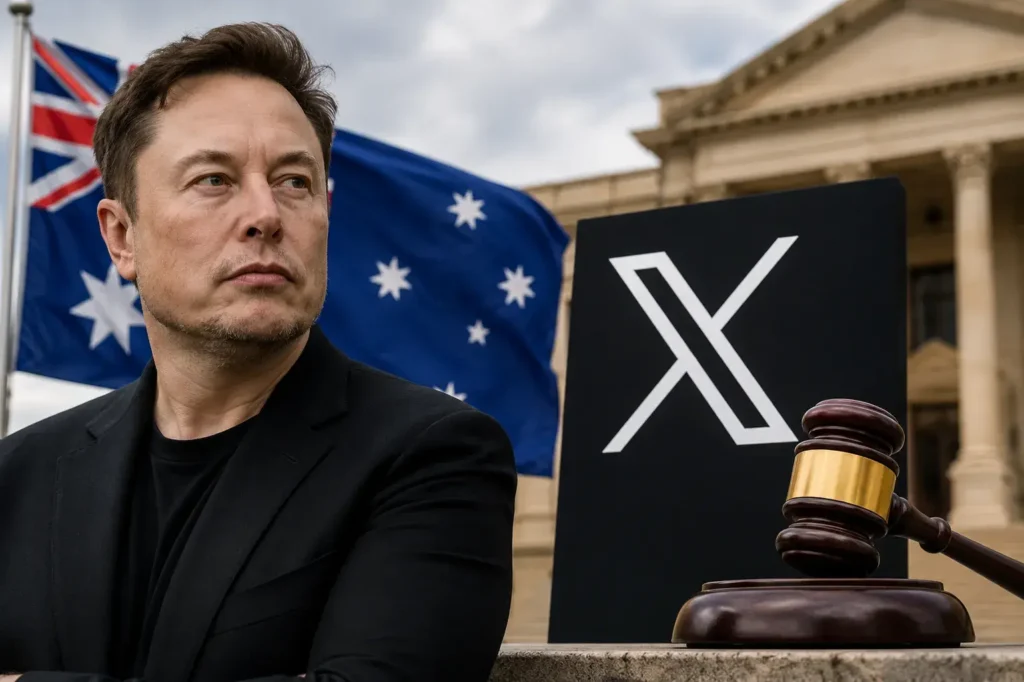
X Corp, the platform formerly known as Twitter, has lost a major legal battle in Australia. The country’s Federal Court has locked in the Elon Musk X Australia fine, ordering the platform to hand over A$650,000. On top of that, the court hit the company with an extra A$100,000 bill to cover the government’s legal expenses because X failed to comply with strict local child safety and transparency rules.
This decision officially wraps up a bitter, three-year dispute between the tech billionaire’s social media giant and Australia’s eSafety Commissioner. The legal outcome serves as a direct warning to big tech companies globally that they cannot simply ignore a country’s local safety laws.
Case Overview: The Legal Breakdown
Niche diye gaye table mein is poore legal dispute ki complete details aur financial penalties ko breakdown kiya gaya hai:
| Case Element | Detail / Specification |
| Primary Subject | X Corp (Formerly Twitter Inc.) |
| Regulatory Authority | Australia’s eSafety Commissioner |
| Core Violation | Non-compliance with Child Safety Transparency Notice |
| Final Penalty Amount | A$650,000 (Increased from the original A$610,000) |
| Legal Costs Ordered | A$100,000 (To be paid to the regulator) |
| Payment Deadline | 45 Days from the court order |
| Presiding Judge | Justice Michael Wheelahan |
Why Did Australia Fine Elon Musk’s X?
The legal dispute dates back to February 2023, when Australia’s eSafety Commissioner issued a formal transparency notice to the platform.
Key Factors Behind the Penalty:
- Lack of Cooperation: The regulator demanded detailed insights into how the company was detecting, reporting, and removing Child Sexual Abuse Material (CSAM) and grooming content. X Corp provided deficient and incomplete responses.
- The Corporate Merger Loophole: X legally challenged the penalty, claiming the notice was served to Twitter Inc. just a month before it merged into X Corp, arguing the new entity shouldn’t be held liable for past notices.
- Court’s Rejection: Justice Michael Wheelahan rejected this defense, affirming that corporate restructuring does not absolve a global platform of its public safety obligations.
Key Takeaway: The court raised the final penalty to ensure the Elon Musk X Australia fine acts as a genuine deterrent, rather than being dismissed as a mere “cost of doing business” by a multi-billion dollar corporation.
Understanding the EEAT Impact: Government vs. Big Tech
From an expert regulatory perspective, this case highlights the escalating friction between sovereign digital laws and the “free speech absolutism” championed by tech executives.
The tension turned deeply personal when Elon Musk publicly targeted Australia’s eSafety Commissioner, Julie Inman Grant. Following Musk’s critical posts, the Commissioner faced severe online harassment, including doxxing and death threats aimed at her family.
Global Scrutiny on Social Media Giants
This ruling is part of a broader, systemic crackdown. Governments worldwide are shifting from passive monitoring to aggressive enforcement regarding:
- Child sexual exploitation material (CSAM) online.
- AI-generated deepfakes and algorithmic abuse targeting minors.
- The negative impact of algorithmic feeds on teenage mental health.
- The accountability of tech CEOs regarding local state laws.
The Future of Digital Regulation and Compliance
Looking ahead, this landmark decision is bound to trigger a chain reaction, prompting nations worldwide to drastically stiffen their internet laws. Regulatory bodies across the European Union, alongside the United Kingdom with its newly minted Online Safety Act, have been tracking this Australian legal saga closely. They are already leveraging these outcomes to sharpen their own regulatory teeth. The days when social media networks could simply police themselves are officially over, replaced by a harsh new reality of mandatory corporate disclosures and crippling financial penalties for non-compliance.
For X Corp, this courtroom loss stands as a highly expensive wake-up call. As governments across the globe roll out increasingly aggressive internet safety mandates, Silicon Valley platforms find themselves at a critical crossroads. Tech executives must now make a definitive choice: either completely overhaul their operational structures to comply with domestic laws, or prepare for an endless cycle of costly lawsuits, escalating fines, and the very real threat of total operational bans in major international markets.

