



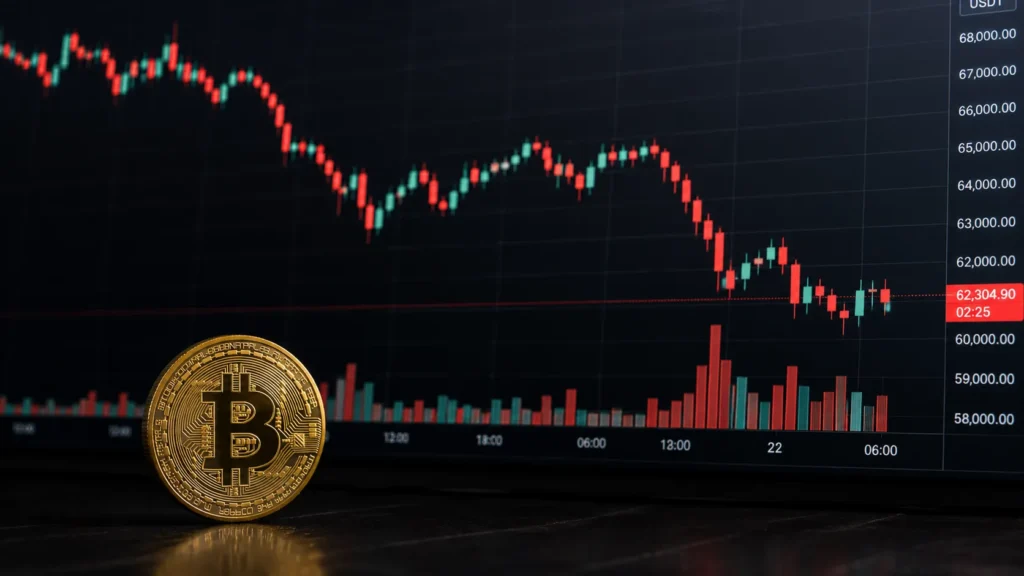
The global cryptocurrency market is experiencing a significant phase of compression as our latest Bitcoin price analysis indicates a massive tug-of-war on the short-term charts. Over the last few sessions, Bitcoin ($BTC$) has been moving strictly sideways, causing a lot of choppy, back-and-forth action that has left intra-day traders highly frustrated. After taking a severe hit downward from its previous local highs, the asset’s price has found itself completely stuck inside a boring, restrictive horizontal box. Right now, buyers and sellers are fiercely fighting for control over a very tight range trapped between the $62,300 support floor and the $64,750 resistance ceiling. However, when you step back and look at the bigger picture, the sellers are clearly still winning this game, keeping the broader macro structure firmly under their thumb. This structural dominance implies that any temporary price jumps or sudden relief rallies will likely face intense selling pressure before the bulls can gain any real ground, as institutional players are not rushing to accumulate at current levels, leaving retail traders to bounce the price between minor boundaries while whales actively use every minor bounce to distribute or exit their spot positions.
To understand why this range-bound action matters, we have to look closely at the underlying market mechanics where the daily range has become a solid defensive wall for the bulls, who are trying desperately to prevent a catastrophic slide below $62,000. On the flip side, whenever the price inches closer to the upper boundary of the rectangle, supply increases almost instantly, pushing the asset right back down toward the middle of the trading channel and reinforcing heavy technical roadblocks that make a genuine recovery incredibly difficult. Specifically, because the price remains firmly stuck below both the 200-period Moving Average and the Ichimoku Cloud on the 4-hour chart, these indicators are acting as formidable overhead ceilings that reject upward momentum. Until Bitcoin manages to break out and secure a strong, high-volume 4-hour candle close well outside the critical $62,300 to $65,500 zone, the path of least resistance remains skewed downward, and we are highly unlikely to see a definitive bullish trend emerge.
What the Charts and Technical Indicators are Showing Right Now
In classical technical trading, when a highly liquid asset undergoes a sharp crash and subsequently begins moving sideways inside a tight rectangle, the chart structure is generally classified as a bearish continuation pattern. This layout essentially means that the market is taking a temporary breathing spell, absorbing remaining buy orders before launching into the next major leg down. Current institutional indicators are leaning heavily toward this exact continuation scenario, signaling that macro risk remains elevated for long-term spot holders.
The market dynamics inside this channel show a clear division between institutional supply and retail defense. The upper boundary near the $64,750 to $65,500 zone is heavily guarded by institutional supply, where large blocks of sell orders are dumped every time the price attempts to rally. Conversely, the lower boundary between $62,300 and $62,800 functions as a temporary floor where retail traders are attempting to buy the dip, resulting in weak, low-volume bounces that fail to sustain upward momentum.
To understand the core mechanics behind this consolidation block, let’s dissect exactly what the key indicators are signaling right now:
- The Moving Average and Cloud Roadblock: The price action is struggling to sustain any real momentum above the 4-hour 200-MA. It is also failing to pierce through the thick overhead layer of the Ichimoku Cloud. This dual failure points to a clear lack of institutional buying interest at current price levels.
- The SuperTrend Resistance Wall: Adding significant weight to this bearish outlook, the trend-following SuperTrend indicator has locked in a massive barrier between $65,000 and $65,400. Even if buyers manage an immediate breakout from the box, they will instantly slam into this heavy supply zone, creating a high risk of a brutal bull trap.
- The Deceptive MACD Crossover: Looking closer at momentum tools for hidden strength reveals a tiny green bullish crossover on the MACD ($-37.12 > -105.28$). However, seasoned market analysts know not to fall for this shift. There is no real buying volume backing the move, meaning sellers are simply resting rather than reversing their positions.
- The Stagnant RSI Reading: Meanwhile, the Relative Strength Index (RSI) is sitting completely flat at 50.74. This reading pins the market in a dead neutral zone, refusing to give swing traders any actionable buy or sell signals and proving that this tedious sideways drift could drag on for a few more sessions.
Strategic Trading Game Plan: Navigating the Boundaries
Attempting to trade inside a choppy, range-bound market structure can severely deplete your capital if you lack a structured operational strategy. Professional traders typically address this specific scenario through three highly distinct execution paths depending on their risk appetite. Aggressive short-term scalpers are currently eyeing the $64,700 level to execute short positions, looking for immediate price rejection at the top of the box to ride a quick rotation back down to the mid-range targets near $63,100 and $62,350.
For more conservative market participants, the optimal play is to remain entirely on the sidelines until a structural breakdown occurs below the $62,300 support floor. A confirmed 4-hour close and a failed retest of that floor would trigger a high-probability short entry targeting much deeper macro levels at $60,800 and potentially $59,500. On the flip side, the counter-trend bullish breakout strategy remains the highest risk approach; it requires waiting for a definitive high-volume close above $65,600 to target $67,250, though buyers must be fully prepared to face a sudden, aggressive roadblock at the overhead 200-period moving average.
Protecting Your Capital: Deep Insights from Pro Traders
If your primary goal is to keep your hard-earned trading capital safe during times of heavy market manipulation, navigating this choppy structure requires institutional-grade risk management. Below is a structured operational breakdown of the major risk factors currently at play and the precise preservation tactics required to survive them.
| Section | Market Risk | Key Explanation | Recommended Action |
|---|---|---|---|
| Risk & Capital Factors | Market Mechanics & Hidden Threats | The current Bitcoin range contains several hidden risks, including random market noise, low-volume fluctuations, fake breakouts, and algorithm-driven price traps. These conditions can easily confuse traders and damage capital. | Traders should avoid emotional decisions and focus on capital preservation until Bitcoin gives a clear breakout or breakdown signal. |
| Professional Preservation Tactics | The Internal Churn Zone | The entire area between $62,800 and $64,700 is considered a strict No-Trade Zone. This range is highly toxic for capital because price action inside it is filled with fake moves, weak volume, and unreliable direction. | Avoid guessing or front-running the next move inside this zone. Wait patiently until Bitcoin breaks an outer boundary with confirmation. |
| Short Squeeze Risk | Threat of a Short Squeeze | Since the bearish bias is clearly visible across multiple timeframes, many retail traders may be heavily shorting Bitcoin near the top of the range. A whale-driven push above $65,000 could trigger forced liquidations and cause a sharp artificial spike. | Do not enter trades based on a quick wick or sudden price jump. Wait for proper confirmation before taking any position. |
| Breakout Confirmation | 4-Hour Candle Close Rule | Sudden liquidity spikes can trap traders on both sides of the market. A move outside the range should not be trusted immediately unless it confirms through candle structure. | Wait for a 4-hour candle close outside the range boundary before treating the move as a real structural breakout. |
| Volatility & ATR Expansion | Daily Volatility Risk | Bitcoin’s Average True Range is currently around $700, showing that normal daily price swings of more than 1% to 1.5% are standard even during consolidation phases. | Adjust trade planning according to volatility. Avoid tight stops and do not over-leverage positions during uncertain conditions. |
| Capital Protection Strategy | Position Size Control | Unexpected intra-day volatility can quickly damage trading accounts when position sizes are too large or risk limits are not clearly defined. | Keep position sizes small, manageable, and strictly within your predefined risk tolerance to survive sudden market swings. |
What to Track Next for the Ultimate Breakout
Moving forward, the single most important metric to track over the next few trading sessions is the volume profile on the daily and 4-hour charts. A breakout that happens on low or average volume is almost always a trap designed to trick retail investors into entering early. Conversely, a massive, undeniable spike in volume accompanied by a clean, decisive candle close past either the $62,300 support or the $65,000 resistance will tell you exactly where the next multi-week macro trend is going to head.
For the bulls to actually step up, save the day, and completely flip the current script, a lot of technical repairing needs to happen on the charts. First, the RSI needs to scale comfortably above the 60 level to show that genuine buying momentum has returned to the market. Second, the SuperTrend indicator must flip its color back to green on the higher timeframes, which would effectively invalidate the dominant bearish continuation thesis that is currently keeping the entire market on edge. Until those two events happen simultaneously, the smartest approach is to assume that the bears maintain structural control and are looking for an opportunity to break this rectangle to the downside.

