



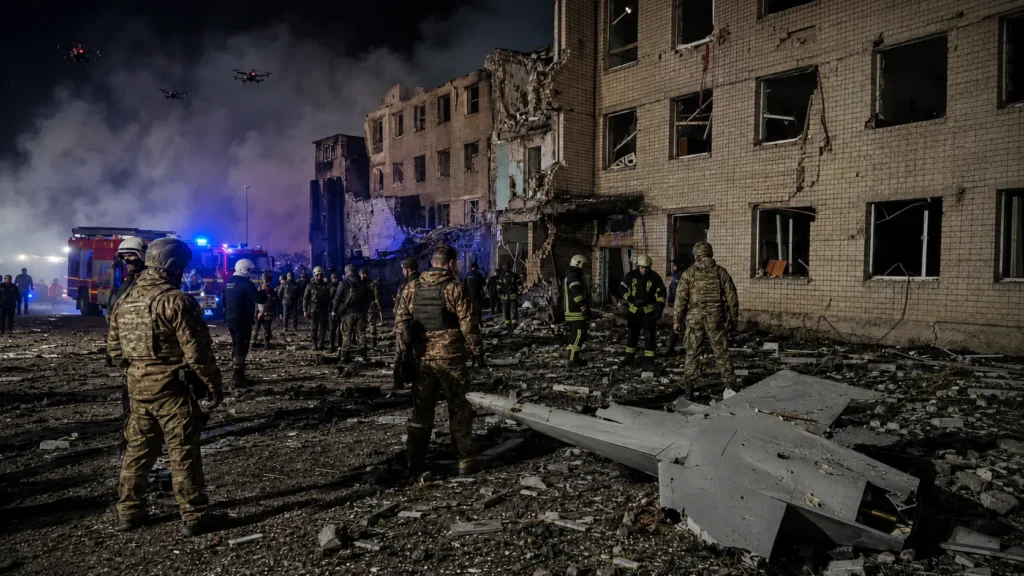
As the frontline standoff deepens, the Russia-Ukraine conflict has turned into a high-tech arena heavily reliant on advanced drone warfare and unmanned systems. A critical example of this evolution is the recent Ukraine-Russia drone strike in the Moscow-controlled town of Starobilsk, Luhansk.
1The incident underscores not only the growing reach of drone warfare across wider regions but also the fierce struggle between both sides to shape public perception and control the narrative surrounding the conflict.”
Fact-Sheet: The Starobilsk Incident at a Glance
The following data summarizes the conflicting reports and technical details surrounding the aerial assault in the Luhansk region:
| Analytical Metric | The Russian Perspective | The Ukrainian Perspective |
| Identified Target | A civilian student dormitory housing youth. | Headquarters of Russia’s elite Rubicon drone unit. |
| Tactical Scale | 16 long-range drones deployed in 3 waves. | Precision strikes aimed strictly at military infrastructure. |
| Human Impact | 6 fatalities, 39 injuries, 15 missing civilians. | High-value enemy military personnel neutralized. |
| Legal Stance | Violation of civilian safety laws by Kyiv. | Legitimate operation under international humanitarian law. |
| Strategic Outcome | Putin ordered military chiefs to draft retaliation plans. | Disruption of Russian drone command networks. |
Detailed Analysis of Conflicting Claims
When analyzing a major Ukraine-Russia drone strike, defense analysts point out that tracking the exact nature of the target is difficult due to the lack of independent boots on the ground.
1. The Kremlin’s Case for Civilian Targeting
Speaking at a formal gathering in Moscow, Russian President Vladimir Putin claimed that the targeted infrastructure had zero connection to military or intelligence operations. Russian state media supported this narrative by broadcasting video evidence of a 19-year-old student, Diana Shovkun, recovering from head injuries caused by falling concrete.
However, independent observers noted that Russian authorities failed to provide immediate photographic or video confirmation of the six reported fatalities.
2. Ukraine’s Tactical Justification
Conversely, Ukraine’s military command maintained that the operation was a highly calculated strike on Russia’s military apparatus. The target of the Rubicon drone unit is a specialized wing accused by Kyiv of launching systematic drone operations against Ukrainian energy grids and residential areas.
By framing the strike as self-defense against an active command center, Ukraine aims to validate its deep-territory actions under the international laws of war.
Secondary Impact: The Vulnerability of Main Energy Hubs
The reach of this particular Ukraine-Russia drone strike wave spread well past Luhansk, exposing critical gaps in the security of Russia’s key commercial and industrial networks.
- Novorossiysk Oil Depot: Falling drone debris ignited a major fire at this vital Black Sea port city, directly damaging administrative centers and a fuel terminal.
- Anapa Domestic Damage: Separate drone fragments caused structural damage to private residential properties along the coast.
These secondary impacts emphasize that modern drone warfare is no longer confined to trenches; it is actively threatening deep economic logistics and shipping lanes.
The Strategic Shift to Deep-Territory Drone Warfare
The tactical clash in Starobilsk highlights a deeper transition toward deep-reconnaissance and long-distance operations. Because the primary battlefronts are heavily locked down, both militaries are increasingly relying on long-range UAVs to bypass frontline defenses and hit targets deep inside rear areas.
“Asymmetric drone strikes allow smaller or deeply defended forces to hit high-value targets, turning fuel depots and intelligence offices into the new frontlines.”
For instance, Ukrainian President Volodymyr Zelensky recently highlighted a separate drone assault that targeted the Moscow-controlled FSB security service headquarters in Kherson, claiming over 100 casualties. This shows that despite heavy air defense grids, low-altitude precision drones remain incredibly difficult to intercept completely.
Conclusion and Future Outlook
The Starobilsk dispute underscores the high human and strategic cost of the current conflict. As Vladimir Putin orders his top military generals to prepare retaliation proposals, the international community anticipates a potential escalation in missile and drone warfare.
Ultimately, this Ukraine-Russia drone strike serves as a case study in modern combat: a single operation can simultaneously disrupt military logistics, cause civilian collateral damage, and trigger a global wave of conflicting geopolitical narratives.

