



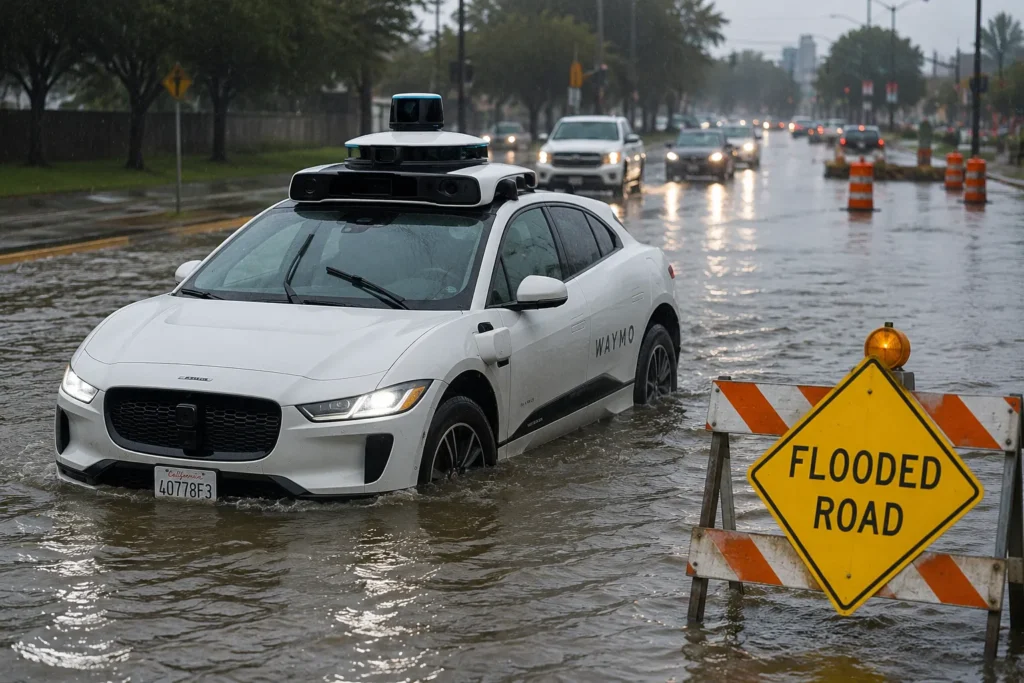
Autonomous driving technology just hit a major roadblock. This week, driverless transport operators confirmed that robotaxi services paused across five major US cities. The sudden shutdown follows a handful of messy road incidents where self-driving cars completely failed to navigate flash floods and active construction zones.
While tech giants love to pitch a future run by driverless cars, these real-world mishaps prove that nature still has the upper hand. Industry insiders admit that while self-driving cars do great on clear, sunny days, heavy rain and unpredictable weather expose some serious flaws in how these vehicles think.
The Incidents That Forced the Shutdown
The tipping point happened in Texas when an empty robotaxi drove straight into a heavily flooded road. Instead of stopping or turning around like any normal driver would, the car kept pushing forward until it lost traction and got swept right into a nearby creek.
A similar mess went down in Georgia just days later. Another driverless taxi drove directly into deep standing water and got stuck, completely blocking traffic and delaying emergency vehicles.
Thankfully, nobody was riding in these cars when things went sideways, but it raised a massive question: why can’t these expensive machines figure out how deep a puddle is?
Why Standing Water Completely Blinds AV Sensors
Even for experienced human drivers, driving into a flooded street is a bad idea. But for an AI, it’s a technical nightmare because:
- Hidden Road Traps: Deep water hides missing manhole covers, deep potholes, and sharp debris that can destroy a tire instantly.
- Zero Tire Grip: Sensors can’t feel the tires losing touch with the road until the car is already sliding out of control.
- Confused Laser Systems: Heavy downpours disrupt the lasers (LiDAR) and cameras that the car uses to see what’s ahead.
The Technical Bug Behind the Recall
Documents filed with the National Highway Traffic Safety Administration (NHTSA) reveal that the issue comes down to a weird software glitch in the vehicles’ latest Automated Driving System (ADS).
What the software did wrong: When the robotaxi approached deep water on fast roads, the onboard computer saw something on the road but didn’t register it as a danger. Instead of stopping the car or picking a new route, the system just slowed down slightly and drove right into the flood.
To fix the mess, the company had to roll out a massive voluntary safety recall for thousands of vehicles so engineers could push out an emergency over-the-air (OTA) software patch.
Where Are the Fleets Currently Grounded?
The temporary shutdown hasn’t closed operations nationwide, but it has completely stopped all rides in five key cities where weather and road layouts caused the biggest headaches.
| City & State | Main Reason for Hitting the Brakes | Estimated Time Offline |
| Austin, Texas | Car swept into creek; severe flash flood risks | 2–3 weeks |
| Houston, Texas | Failed to detect deep water on highway service roads | 2–3 weeks |
| Dallas, Texas | Software got confused by shifting construction zones | 1–2 weeks |
| San Antonio, Texas | Preventive shutdown due to heavy rain forecasts | 1 week |
| Atlanta, Georgia | Vehicle stranded in deep water, blocking a major road | 2–3 weeks |
It’s Not Just Water-Freeways Are a Mess Too
On top of the flooding issues, these companies have also quietly paused their driverless car tests on freeways in several big markets. The reason? Construction zones.
Highway construction is pure chaos. Lanes shift overnight, plastic cones replace solid white lines, and workers use hand signals instead of signs. While a human driver can easily make a quick judgment call or look a construction worker in the eye, an AI system gets overwhelmed when the real world doesn’t match its pre-downloaded maps.
The Road Ahead: Can Public Trust Be Rebuilt?
At the end of the day, a temporary pause like this is just a normal part of building new tech. Every time a robotaxi fails in public, engineers get the exact data they need to make the software smarter next time.
However, public patience is wearing thin. For these services to become a normal part of everyday life, people need to know that their taxi won’t drive them into a river during a storm.
Voluntary recalls and being honest about mistakes are good steps, but city regulators are going to demand much stricter testing from here on out. Until these vehicles can prove they can handle the absolute worst weather conditions safely, the dream of a fully driverless city will have to wait.

